
Dark Horse Tattoos: Meanings, Designs & Cost

Updated: Sep 10
Dark horse tattoos are a powerful choice for anyone who identifies with the underdog — the contender nobody expects to win, who triumphs through perseverance and quiet strength. Rooted in a 19th-century horse-racing idiom, the dark horse has become a universal symbol of hidden potential, unexpected success, and the journey from being underestimated to emerging victorious. This guide covers the meaning, designs, styles, placements, cost, and aftercare.
📌 Key Takeaways (TL;DR)
Core Meaning: The underdog — hidden potential, unexpected success, quiet strength, overcoming obstacles.
Term Origin: From 19th-century horse racing — a little-known competitor who surprises everyone by winning.
Top Designs: Realistic horse, minimalist/line, traditional, geometric, galloping horse, horse + moon.
Styles: Black and grey realism, fine line, watercolor, traditional, geometric.
Cost: $150 for a small minimalist piece to $1.500+ for a full realistic back piece.
Best Placements: Forearm, upper arm, chest, back, thigh.
Table of Contents
1. What Does a Dark Horse Tattoo Mean?

At its core, the image of a dark horse represents the underdog — a contender who appears unlikely to succeed but ultimately triumphs through perseverance and innate strength. (Source: LA Tattoo Shop)
This powerful meaning attracts people who relate to overcoming obstacles, proving doubters wrong, or quietly working toward their goals while avoiding the spotlight. The dark horse represents:
Hidden potential — abilities and strength that aren't immediately obvious.
Resilience — enduring challenges and emerging stronger.
Unexpected success — the surprise victory nobody bet on.
Personal transformation — the journey from being underestimated to emerging victorious.
Quiet strength — determination that doesn't need to show off.
Comeback — marking a chapter where quiet strength carried someone through.
The imagery is not strictly masculine or feminine — it's universally appealing across cultures and genders, making it one of the most versatile meaningful tattoo choices.

2. The Origin of the Term "Dark Horse"

The phrase that inspired the dark horse tattoo comes from 19th-century English and American horse racing. (Source: Inker.ai)
A dark horse was a racehorse about which little was known — a competitor unknown to bettors who could surprise everyone by winning.
The idea migrated into politics and common speech: a "dark horse" became an unexpected contender or underdog who rises to prominence.
Today, in tattoo culture, the motif celebrates quiet hustle, late success, and the nonconformist arc — anyone who values surprise, grit, and winning against the odds.
Cultural note: the dark horse (underdog) should not be confused with the pale horse of Revelation — a much heavier, gothic image associated with death. The dark horse is about unexpected triumph; the pale horse is about mortality. They don't blend with the freedom reading — pick one lane.
3. Popular Dark Horse Tattoo Designs
Design | Look | Meaning |
Realistic horse | Lifelike, detailed shading | Power, elegance, hidden strength |
Minimalist / line horse | Clean lines, silhouette | Quiet strength, understated confidence |
Traditional horse | Bold outlines, classic colors | Enduring, historic tattoo culture |
Geometric horse | Shapes, symmetry, negative space | Modern, abstract, hidden order |
Galloping horse | Full-body in motion | Forward motion, overcoming obstacles |
Horse head | Head-and-mane crop | Expression, focus, the essential image |
Rearing horse | Raised on hind legs | Power, defiance, readiness (heraldic) |
Silhouette | Solid black shape | Mystery, the hidden self |
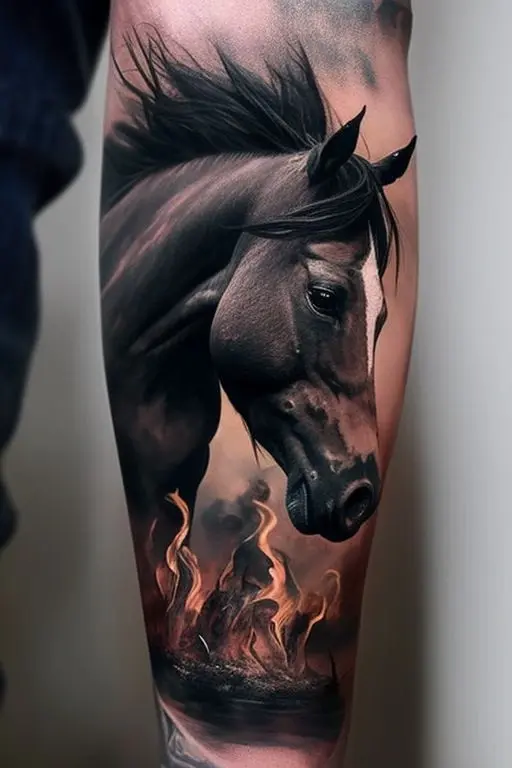
The head-and-mane crop — head, neck, flowing mane, cropped at the shoulder — is the composition most artists recommend. It keeps the eye, nostril, and jawline (the features that carry expression) and reads well at forearm scale. A full-body horse needs at least six inches or the legs become sticks.
4. Dark Horse Tattoo Styles

Style | Look | Longevity |
Black and grey realism | Smooth gradients, wet highlight on eye | Excellent (with enough size) |
Fine line | Single-weight gesture lines | Vulnerable — design for softening |
Traditional / neo-traditional | Bold outlines, flat color | Best aging — decades |
Watercolor | Soft blended washes | Needs upkeep |
Geometric | Polygonal, symmetrical | Good |
Tribal | Bold black shapes, patterns | Excellent |
Black and grey realism is the strongest match for the horse — the animal's form is built from value transitions. Traditional solves the muscle problem by not pretending: bold outlines and flat color age better than any other approach. Fine line horses work best when they lean into gesture — more calligraphy than portrait.
5. Dark Horse + Other Elements (Design Combinations)

Combination | Meaning |
Dark horse + moon | Mystery, transformation, spiritual awakening |
Dark horse + clock | Triumph over time, patience, timing |
Dark horse + roses | Beauty emerging from adversity |
Dark horse + wings | Freedom, transcending limitations |
Dark horse + hurdle | Overcoming major life challenges |
Dark horse + stars | Guidance, destiny, hidden potential |
Dark horse + lightning | Sudden power, striking energy |
Combining the dark horse with other symbols adds depth and personalization — each element amplifies the narrative of quiet strength and unexpected triumph.
6. Best Placements for Dark Horse Tattoos

Placement | Pain (1–10) | Why It Works |
Outer forearm | 3–4 | Workhorse placement for head-and-mane designs |
Upper arm / bicep | 3–4 | Balance of visibility and flexibility |
Chest / sternum | 6–8 | Intimate, guarding the heart |
Back | 4–6 | Only place for herd/landscape/mounted figures |
Thigh | 4–5 | Enough real estate for a full running/rearing horse |
Calf | 4–5 | Leg's curve suits a body in motion |
Ribs | 8–9 | Large narrative scenes, private |
Ankle / wrist | 6–7 | Small minimalist designs |
The outer forearm is the workhorse placement — the mane sweeps along the limb for a natural flow. The thigh and calf give enough space for a full running or rearing horse. The back is the only place where a herd, a landscape, or a mounted figure genuinely fits.
7. How Much Does a Dark Horse Tattoo Cost?

Size / Type | Estimated Cost |
Small minimalist / line horse | $150–$300 |
Medium detailed horse (forearm, calf) | $300–$700 |
Large realistic piece (thigh, back) | $700–$1.500+ |
Full back / elaborate composition | $1.500–$3.500+ |
Most artists charge $150–$300 per hour. Smaller minimalist designs are budget-friendly; elaborate full-color or back pieces command higher prices due to the hours and expertise involved. Always prioritize quality over cost for meaningful body art meant to last a lifetime.
8. Dark Horse Tattoo Aftercare
A dark horse tattoo — especially one with fine shading or realistic detail — needs proper care to stay crisp and dimensional.
Immediate aftercare (days 1–14):
Keep the tattoo clean; wash gently 2–3 times a day with a gentle, fragrance-free hand soap and pat dry — never rub.
Apply a healing ointment like Hustle Butter Deluxe or Aquaphor Healing Skin Ointment to keep shading smooth without clogging the skin.
For shaded or realistic pieces, Saniderm Tattoo Bandages trap plasma and prevent the thick scabbing that can blur subtle grey tones. Leave on 3–5 days.
Long-term:
Sun protection is critical — UV fades and blurs fine detail, especially on exposed placements. Use a high-SPF tattoo sunscreen like Mad Rabbit SPF 30 daily.
Moisturize regularly with an unscented lotion like Eucerin Advanced Repair Lotion — hydrated skin keeps black and grey shading smooth and dimensional.
Pro tip: For a detailed realistic horse, the Perfect Tattoo Guide 2.0 helps you vet an artist's animal-portrait portfolio before committing.
9. Frequently Asked Questions

What does a dark horse tattoo mean?
A dark horse tattoo symbolizes the underdog — hidden potential, unexpected success, resilience, and quiet strength. It represents overcoming obstacles, proving doubters wrong, and triumphing against the odds.
Is a dark horse tattoo only for men or women?
No. The symbolism of the dark horse is universal — it's a powerful statement for anyone drawn to its meaning, regardless of gender. Style and placement can be tailored to any preference.
How much does a dark horse tattoo cost?
A small minimalist piece costs $150–$300, a medium detailed horse $300–$700, a large realistic piece $700–$1.500+, and full back compositions $1.500–$3.500+.
Where is the best place to get a dark horse tattoo?
The outer forearm is the workhorse placement for head-and-mane designs. The thigh and calf suit full running or rearing horses. The back fits elaborate scenes.
What's the difference between a dark horse and a pale horse tattoo?
The dark horse represents the underdog — unexpected triumph and hidden potential. The pale horse of Revelation is ridden by Death — a much heavier, gothic image of mortality. They don't blend; pick one lane.
Do dark horse tattoos hurt?
Pain depends on placement. The forearm, upper arm, and thigh are comfortable (3–5/10); the chest, ribs, and ankle are more sensitive (6–9/10).
What's the best style for a dark horse tattoo?
Black and grey realism captures the horse's form beautifully. Traditional ages best — bold outlines and flat color last decades. Fine line is elegant but most vulnerable to aging.
Can I combine a dark horse with other symbols?
Yes — the dark horse pairs with moons (mystery), clocks (triumph over time), roses (beauty from adversity), wings (freedom), and lightning (sudden power).
10. References & Sources
About the Author
Leonardo Pereira — founder of Tatuagem Blog, has been researching and writing about tattoo art, symbolism, and aftercare since 2017. This guide was reviewed against design and cultural sources, and content intent was aligned to real search behavior, verified in September 2026.


Comments