
Greek God Tattoo Meanings: Designs, Placement & Cost

A Greek god tattoo is never just a portrait — it's a statement about the qualities you carry or aspire to carry. In Western tattoo culture, gods like Zeus, Poseidon, Hades, and Athena have become shorthand for specific traits: power, emotional depth, transformation, and wisdom. Understanding what each deity represents is the difference between a tattoo that looks cool and one that says exactly who you are. This guide breaks down the meaning of every major god and goddess, the styles that suit each, honest cost expectations, and the placements that make mythology ink truly shine.
Key Takeaways (TL;DR) A Greek god tattoo symbolizes the specific trait you want to embody — Zeus for power, Poseidon for emotional depth, Hades for transformation, Athena for wisdom, Ares for courage. The Big Three (Zeus, Poseidon, Hades) and Athena are the most requested figures; Medusa and mythical creatures are the fastest-growing trend. Dominant styles: black & grey realism and statue-style (timeless, ages well); minimalist symbols are the budget option. Costs run $150–$500 for a small symbol, $400–$1.200 for a medium portrait, and $1.500–$5.000+ for a full back or chest piece. Best placements: upper arm/shoulder for power gods, forearm for wisdom figures, thigh for goddesses — with pain ranging 3–8/10 depending on the spot.
Table of Contents
Why Greek God Tattoos Endure

Greek mythology has been tattooed for decades, but it exploded into a mainstream trend in the last few years — Forbes even dubbed it "the mythology tattoo" summer in 2023, with artists reporting Greek gods as some of the most requested designs of the season. The appeal is timeless: these are not just powerful images, they are archetypes. Each god condenses a human quality into a face, a weapon, and a story. When you choose a god, you're choosing the version of yourself you want to emphasize — and that's why the decision matters more than the aesthetics.
The most important step before booking is deciding which trait you want to carry. That choice determines the god, the symbols, the style, and even the placement. Here's everything you need to decide.
Zeus: Power and Authority

The king of the Olympians is the most requested Greek god for tattoos — and the meaning is layered, not simple. Zeus represents overcoming adversity: he was the youngest son of Cronus, saved from being swallowed by his father, raised in secret on Crete, and later led the Titanomachy — the ten-year war that overthrew the Titans and made him king. His symbols tell the full story: the lightning bolt (the weapon the Cyclopes forged for him as thanks for freeing them), the eagle (his sacred animal, vision and kingship), the throne (his seat of authority), and the oak (endurance and stability).
Because of that story, a Zeus tattoo can mean ambition — rising to the top and claiming your throne — but also the responsibility that comes with power: with great power comes great consequence. It's the choice of leaders, entrepreneurs, and anyone who has fought their way up against opposition.
The most popular Zeus designs are the lightning bolt alone (a minimalist statement perfect for a forearm or wrist), Zeus with the eagle, Zeus on his throne, the bearded portrait, and dramatic scenes of Zeus versus the Titans for large back pieces. For a full breakdown of every Zeus design, cost, and placement, see our dedicated Zeus Tattoo guide.
Poseidon: Emotional Depth and Adaptability

Where Zeus rules the sky, Poseidon rules the sea — and that distinction changes everything about the meaning. Poseidon represents the power of nature: untamed, unpredictable, awe-inspiring. He is also the god of emotional depth, because the ocean has always been the ancient symbol of the subconscious: deep, vast, and full of things you can't see from the surface. And he embodies adaptability — water takes the shape of any container, flows around obstacles, and always finds a way.
A Poseidon tattoo is often chosen by people who identify with emotional intensity, acknowledge their own temperament, and see themselves as deep rather than shallow. The trident is the classic minimalist symbol; fuller designs show Poseidon rising from the waves, his face combined with an ocean background, or epic sea scenes with horses (his sacred animal) and storms.
Poseidon pieces work beautifully on the forearm with the trident pointing down, the shoulder, the calf, and the back for large wave scenes. If you love the sea symbolism but want to explore the broader meaning of the symbol, our lightning bolt tattoo guide covers the storm side of his domain — and the broader mythology symbol set lives in our Greek god hub.
Hades: Transformation and the Shadow Self

Hades is the most misunderstood god — and that's exactly why his tattoos resonate so deeply. He is not the devil of popular culture; in Greek myth, he is a stern, fair, and just ruler of the Underworld. That nuance makes Hades the god of transformation and rebirth (death as change, not ending), the shadow self (embracing the parts we hide), justice (he judged the dead fairly), wealth (he controlled the riches beneath the earth — his Roman name, Pluto, literally means wealth), introversion, and loyalty (one of the few faithful husbands in Greek mythology).
People choose Hades when they feel misunderstood, work through their dark side intentionally, or identify with depth over surface. The signature designs are Hades on his throne, Hades with Cerberus (his three-headed guard dog), Hades and Persephone (their complex, enduring love story), the helm of darkness (his symbol of invisibility), and the pomegranate (Persephone's binding to the Underworld). Dark, shadowy blackwork and black & grey realism are the natural styles.
For the complete deep-dive on the Underworld god — including why his dedication to Persephone makes him one of the most romantic choices in mythology — see our dedicated Hades Tattoo guide.
Athena: Wisdom and Strategy

Athena is the definitive goddess of wisdom, strategy, and feminine strength. She was born fully armed from Zeus's forehead — a story that has made her the symbol of wisdom that doesn't wait for permission. She represents strategic thinking, justice, craftsmanship, and protection (she was the patroness of heroes and the protector of Athens). For women especially, she has become the ultimate symbol of intelligence and independence: a powerful woman who commanded respect and needed no one.
Athena's designs are instantly recognizable: the owl (her sacred animal, wisdom — one of the most popular small Greek tattoos in the world), the shield and spear (the warrior goddess), her helmet, the olive tree (her gift to Athens, victory in the contest against Poseidon), and her wise, strong portrait. She pairs beautifully with the owl as a minimalist piece or as a full portrait with the Aegis shield.
Athena tattoos are most popular on the thigh (a large, concealable canvas favored by women), the shoulder, the upper arm, and the forearm. For every Athena design, meaning, and price range, see our dedicated Athena Tattoo guide.
Apollo, Ares, Artemis, Aphrodite, Hermes and Dionysus

Beyond the Big Three and Athena, each remaining deity offers a distinct trait. Apollo represents light, art, music, and truth — designs include the lyre, sun rays, the laurel wreath (victory and poetry), and the bow and arrow. Ares is the god of war: warrior spirit, raw courage, and intensity — his helmet, spear, and shield are the classic symbols, worn best on the upper arm and chest. Artemis, Apollo's twin, is the goddess of the hunt and the moon — independence, wilderness, and protection of women — rendered as a bow, a deer, or a crescent moon, and especially popular among women.
Aphrodite is the goddess of love and beauty — emerging from the shell, or paired with doves, often chosen to celebrate love, femininity, and self-worth. Hermes, the messenger god, symbolizes communication, travel, commerce, and speed — his winged sandals and the caduceus suit travelers and entrepreneurs. And Dionysus, the god of wine and ecstasy, represents pleasure, celebration, breaking boundaries, and the creative chaos that artists and free spirits love — grapes, vines, and the leopard are his signatures.
Deity | Core Meaning | Classic Symbols | Best Placements |
Apollo | Light, art, truth, victory | Lyre, sun rays, laurel wreath | Forearm, shoulder, upper back |
Ares | War, courage, intensity | Helmet, spear, shield | Upper arm, chest, back |
Artemis | Independence, the hunt, the moon | Bow, deer, crescent moon | Thigh, forearm, shoulder |
Aphrodite | Love, beauty, femininity | Shell, doves, roses | Thigh, ribs, collarbone |
Hermes | Communication, travel, commerce | Winged sandals, caduceus | Forearm, calf |
Dionysus | Pleasure, celebration, creativity | Grapes, vines, leopard | Back, upper arm |
This table is your fast reference when narrowing the choice — but the best choice is the god whose core meaning matches your own story, not just your favorite aesthetic.
Greek God Tattoo Styles and What They Cost

The style you choose is as important as the deity — it decides how the piece ages and how much it costs. Black & grey realism is the dominant choice for Greek gods, and for good reason: the dramatic lighting and shading that make a bearded Zeus or a marble-like statue feel three-dimensional also age beautifully, since black & grey fades more gracefully than heavy color. Statue-style (the classic marble bust look) is a close second — it reads instantly as "Greek mythology" and is the most elegant option for placements like the forearm. Neo-traditional brings bold lines and vibrant colors for a more colorful, modern take. Geometric versions use sacred geometry for a contemporary, structured look. And minimalist god symbols — the lightning bolt, the trident, the owl, the laurel wreath — make small, discreet, and affordable statements.
Styles range from $350–$3.000+: minimalist symbols are the budget option ($150–$600), geometric runs $350–$1.500, black & grey and neo-traditional sit mid-range ($400–$2.000), and full realism portraits are the premium investment ($600–$3.000+) because they demand an artist who truly masters faces, musculature, and lighting.
Best Placements for Greek God Tattoos

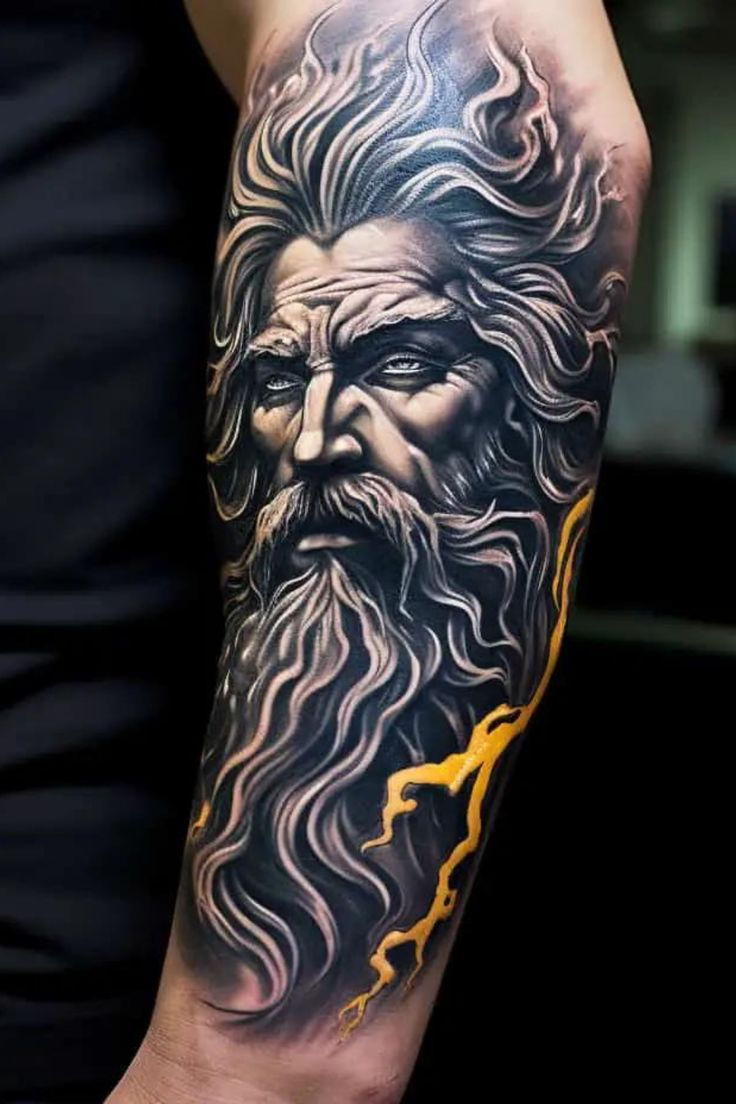


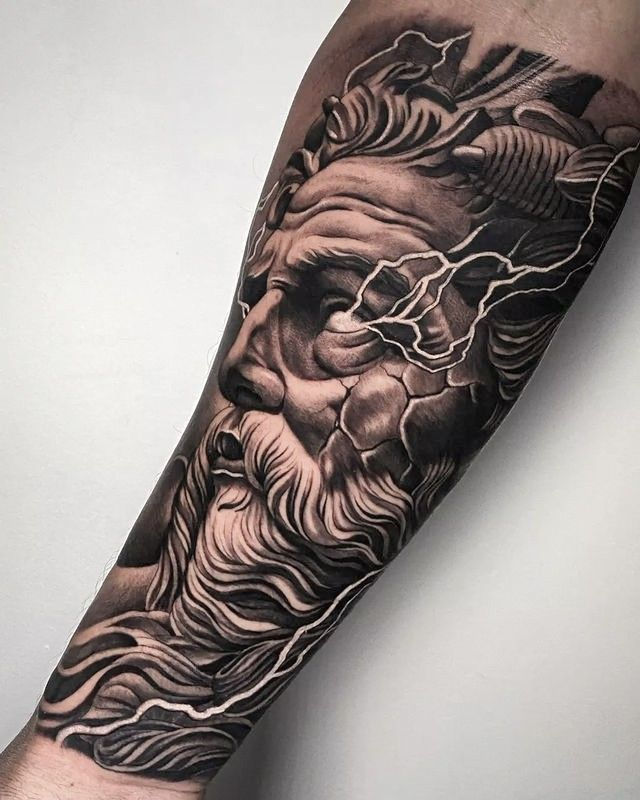

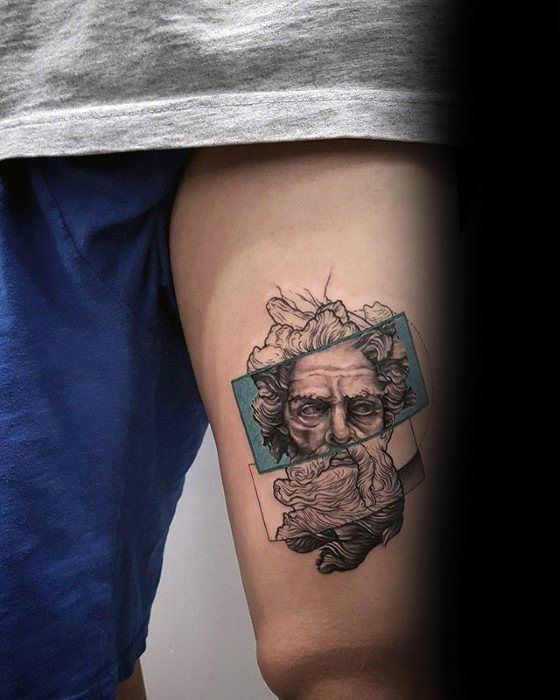
Placement should follow both the size of the design and the symbolism. Power gods (Zeus, Ares, Poseidon) belong on the upper body — the muscles of the upper arm, shoulder, and chest amplify their strength. Wisdom figures (Athena, Apollo, Hermes) work beautifully on the forearm, where the piece is visible and serves as a constant reminder.
Goddesses and larger portraits suit the thigh — a large, concealable canvas that ages well. And for full mythology scenes or combining multiple gods (the classic "Big Three" sleeve), the back is the only canvas big enough.
Placement | Pain (1–10) | Cost Range | Best For |
Upper arm / shoulder | 3–4 | $400–$1.500 | God portraits, power symbolism |
Forearm | 3–4 | $300–$1.000 | God symbols, wisdom figures |
Thigh | 4–5 | $500–$2.000 | Goddesses, large portraits |
Back | 4–7 | $800–$3.000+ | Full scenes, multiple gods |
Chest / sternum | 6–8 | $500–$2.500 | Personal, protection symbolism |
How Much Does a Greek God Tattoo Cost?

Greek god tattoos range from $150 to over $5.000, driven by size, style, and detail. The biggest cost driver is realism: a photorealistic Zeus portrait takes hours of careful shading and demands a premium artist, which is why realistic portraits are the most expensive type of Greek ink.
Size / Type | Estimated Cost |
Small god symbol (3–4 in) — bolt, trident, owl, laurel | $150–$500 |
Medium portrait (5–8 in) | $400–$1.200 |
Large detailed scene (8–12 in) | $800–$2.500 |
Full back / chest piece | $1.500–$5.000+ |
Most artists charge $150–$300 per hour, and realism sits at the premium end. Before committing to a large mythology piece, the Perfect Tattoo Guide 2.0 walks through vetting a realism artist's healed portfolio — the single most important step for a god portrait that has to age for decades.
Choosing the Right Artist

A Greek god tattoo — especially a realistic or statue-style piece — lives or dies on the artist's skill with human faces, musculature, and dramatic lighting. When vetting artists, ask these five questions: How many Greek mythology tattoos have you done? Can I see healed photos of similar work (not just fresh)? Are you familiar with the symbolism behind the god? What style do you recommend for my vision and placement? And what's the total cost and timeline? Beard texture, marble-like shading, and godly eyes are exactly the details that blur with age if the artist over-shares or rushes — so healed portfolios are non-negotiable.
Greek God Tattoo Aftercare
A detailed mythology piece is dense with shading and fine detail, which means aftercare decides how crisp it stays. In the first days, keep the artist's Saniderm bandage on as directed, then wash gently with a fragrance-free hand soap two to three times daily and pat dry — never rub. Apply thin layers of Hustle Butter Deluxe or Aquaphor Healing Skin Ointment to keep dense shading moisturized without suffocating the skin. For large pieces that swell, compression garments help, and loose cotton clothing prevents friction against the design.
Long-term, sun protection is non-negotiable — realism shading is the first thing UV erases, so use a high-SPF tattoo sunscreen like Mad Rabbit SPF 30 daily on exposed areas and keep the ink saturated with Eucerin Advanced Repair Lotion. Supporting healing from the inside with protein supplementation during heavy healing weeks gives your skin the building blocks for tissue repair. Expect professional touch-ups every 5–7 years for detailed work.
FAQ — Greek God Tattoos Explained
What does a Greek god tattoo symbolize?
A Greek god tattoo symbolizes the trait you want to embody: power and authority (Zeus), emotional depth and adaptability (Poseidon), transformation and the shadow self (Hades), wisdom and strategy (Athena), or courage and warrior spirit (Ares). Each god is an archetype — the tattoo is a statement about who you are or who you aspire to be.
Which Greek god tattoo is best for strength?
Zeus (power and authority), Ares (warrior spirit), and Hercules (heroic strength) are the top choices. Combine the god with their symbols — Zeus with the lightning bolt, Ares with his helmet and spear — to emphasize the strength message.
Which Greek god tattoo is best for wisdom?
Athena is the definitive choice for wisdom and strategy, followed by Apollo for intellectual and artistic brilliance. Athena's owl and Apollo's laurel wreath are the classic wisdom symbols.
Can I combine multiple Greek gods in one tattoo?
Yes — and it's increasingly popular. The classic "Big Three" sleeve combines Zeus, Poseidon, and Hades as a shifting scene between sky, sea, and underworld. Zeus and Athena explore the father-daughter relationship, and a full pantheon scene on the back tells a complete mythology story. Just make sure the composition has room to breathe.
How much does a Greek god tattoo cost?
Small god symbols cost $150–$500; medium portraits run $400–$1.200; large detailed scenes cost $800–$2.500; and full back or chest pieces reach $1.500–$5.000+. Realism is the most expensive style ($600–$3.000+); minimalist symbols are the least expensive ($150–$600).
Where should I place a Greek god tattoo?
Power gods belong on the upper arm, shoulder, or chest. Wisdom figures suit the forearm. Goddesses and large portraits favor the thigh. Full mythology scenes need the back. Pain ranges from 3–4/10 on the arm and forearm to 6–8/10 on the chest and sternum.
How long does a Greek god tattoo take to heal?
Initial healing takes 2–4 weeks, with full settling of deeper layers taking several months for large, heavily shaded pieces. Dense black & grey realism settles faster than heavily colored scenes, and both need consistent aftercare.
Is Greek mythology tattoo cultural appropriation?
No — Greek mythology is a shared cultural heritage that has been depicted worldwide in art for millennia, not a closed or sacred practice. The respectful approach is to use it knowingly: learn the mythology, choose the symbols that genuinely speak to you, and let a skilled artist do the subject justice.
Conclusion
Greek god tattoos endure because they are archetypes — each deity condenses a human quality into an image powerful enough to carry for life. Whether you choose Zeus for the power earned through defiance, Poseidon for emotional depth, Hades for transformation, Athena for wisdom, or the warrior courage of Ares, you're wearing a symbol that has shaped Western storytelling for three thousand years. The key is choosing the god whose meaning matches your story, matching them with a style that ages well, and trusting an artist whose healed work speaks for itself.
References & Sources:
Related guides: Zeus Tattoo · Athena Tattoo · Hades Tattoo · Lightning Bolt Tattoos


Comments