
100+ Dog Tattoo Ideas: Ultimate Guide to Styles, Meanings & Placement [2026]

Updated: Aug 18
A dog tattoo is a permanent piece of body art that symbolizes unconditional love, lifelong loyalty, protection, and companionship. Whether created as a living tribute to a cherished pet, a memorial to heal after a loss, or a stylized portrait, dog tattoos capture the profound bond between humans and their canine companions.
From hyper-realistic portraits that capture every strand of fur to minimalist single-line outlines, choosing the right design is a deeply personal journey.
In this ultimate guide, you’ll discover over 100 inspiring dog tattoo ideas categorized by style and breed, expert placement recommendations, customization tips, and essential aftercare advice to ensure your ink stays sharp for a lifetime.
Table of Contents
What Does a Dog Tattoo Symbolize?
A dog tattoo primarily symbolizes unconditional love, unwavering loyalty, deep companionship, and protection. Beyond celebrating a living pet, dog tattoos frequently serve as meaningful memorials to honor a deceased companion or represent personal strength through specific breed characteristics.
Loyalty, Unconditional Love & Companionship
Dogs have earned their title as humanity's best friend through thousands of years of devotion. A dog tattoo captures this unique bond, serving as a permanent tribute to the unyielding loyalty and joy a pet brings into your daily life. Whether simple or complex, the ink represents a connection built on trust, affection, and shared memories that time cannot erase.
Pet Memorials & Grief Healing
Losing a pet is one of life’s most profound heartbreaks. A memorial dog tattoo transforms grief into a lasting celebration of your companion's life. By etching their portrait, paw print, or silhouette onto your skin, you carry a physical reminder of their presence everywhere you go, offering comfort, healing, and a sense of closeness long after they have passed over the rainbow bridge.
Protection, Guarding & Personal Power
Beyond personal pets, dog tattoos carry historical and psychological symbolism tied to guardianship and power. Breeds known for their protective nature—such as Dobermans, Rottweilers, or Mastiffs—are often chosen to represent personal boundaries, resilience, inner strength, and ferocity in protecting what matters most. In mythology and folklore, dogs frequently act as guardians of spiritual thresholds, making these designs symbolic of guidance through life's transitions.

Dog Tattoos by Style

Realistic & Hyper-Realistic Dog Portraits
Realistic dog tattoos aim to mirror a photo with exacting precision. Utilizing advanced shading techniques, micro-detail needlework, and precise light capture, artists recreate every strand of fur, the reflection in the pet's eyes, and the texture of their nose. Available in rich color or dramatic black-and-grey, hyper-realism requires a highly specialized artist to ensure the pet's unique expression translates accurately onto skin.
Minimalist & Fine-Line Dog Tattoos
Minimalist tattoos focus on clean aesthetic lines, single-line silhouettes, and subtle continuous contours. This style eliminates heavy shading and complex color palettes in favor of elegance, negative space, and simplicity. Fine-line dog tattoos are discrete, timeless, and ideal for those seeking a delicate tribute that fits effortlessly onto smaller body areas like the wrist, ankle, or behind the ear.
Traditional & Neo-Traditional Dog Tattoos
Classic American Traditional tattoos feature bold black outlines, a limited color palette (reds, yellows, greens), and iconic framing elements like banners, roses, or daggers. Neo-Traditional expands on this foundation with varied line weights, richer color gradients, and detailed ornamental backgrounds while preserving the bold, long-lasting structure that ensures the tattoo ages exceptionally well over decades.
Watercolor Dog Tattoos
Watercolor dog tattoos replace defined borders with fluid splashes, drips, and vivid color gradients that mimic painterly canvas art. This style works exceptionally well for vibrant personalities, blending soft pastels or dramatic jewel tones around a line-work silhouette or a semi-realistic portrait to give the piece movement, energy, and artistic flair.
Micro-Realism & Small Dog Tattoos
Micro-realism packs all the intricate detail of a large realistic portrait into a design no bigger than a coin or a postage stamp. Utilizing ultra-fine needles, artists construct tiny fur textures, realistic eyes, and subtle highlights. This style offers the emotional depth of a full portrait while maintaining a subtle footprint suitable for sensitive or small placements.
Geometric & Mandala Dog Tattoos
Geometric dog tattoos merge the organic contours of a canine with structured shapes, symmetry, crisp lines, and mathematical patterns. Artists often split the design in half—rendering one side as a realistic portrait and the other as a geometric or mandala pattern—creating a modern contrast between nature and structured design.
Blackwork & Silhouettes
Blackwork relies entirely on solid black ink, heavy contrast, and strategic negative space. Silhouettes capture the unmistakable outline of a specific breed or pet posture, delivering high visual impact with a bold, graphic look that remains bold and clear for a lifetime.
Dog Tattoos by Breed
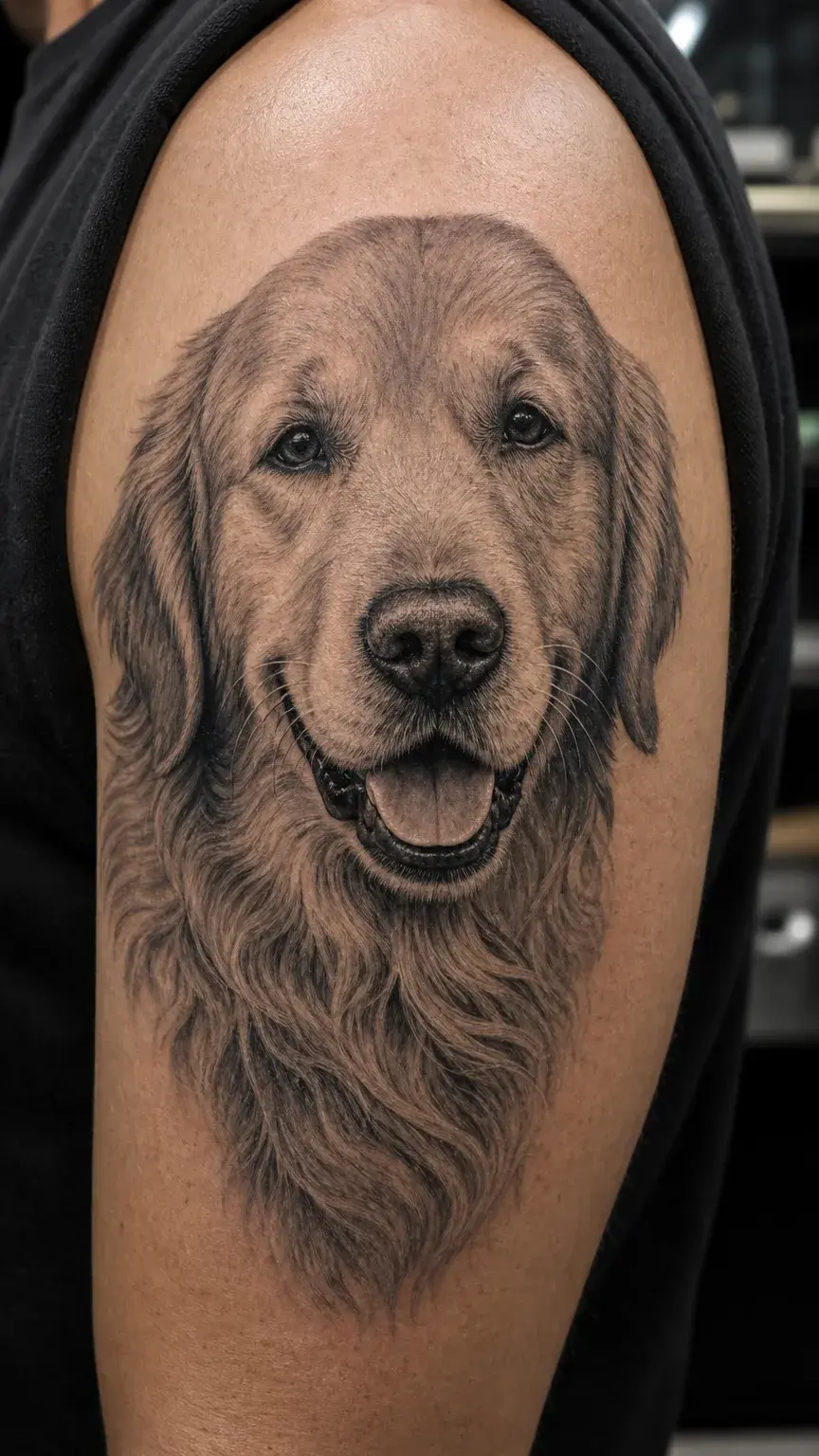
Golden Retriever & Labrador Tattoos
As two of the most popular breeds globally, Golden Retrievers and Labradors are recognized by their expressive eyes, floppy ears, and gentle smiles. Tattoos of these breeds frequently emphasize warmth, joy, and open companionship, often styled in soft black-and-grey realisms or warm watercolor tones.
German Shepherd & Rottweiler Tattoos
German Shepherds and Rottweilers feature distinct physical traits—sharp alert ears, noble profiles, and powerful muscular builds. Tattoos featuring these breeds highlight protection, intelligence, and unwavering loyalty. Popular design approaches include regal side-profile portraits, bold traditional frames, or high-contrast blackwork.
Pit Bull & Staffy Tattoos
Pit Bulls and Staffordshire Terriers have broad heads, expressive brows, and wide "smiles." Tattoos of these breeds often celebrate their gentle, affectionate nature, frequently paired with floral crowns or soft framing to counter negative stereotypes and showcase their true devotion.
French Bulldog, Boston Terrier & Pug Tattoos
Brachycephalic (short-muzzled) breeds possess distinct visual characteristics—bat ears, wrinkled snouts, and large round eyes. Tattoos of Frenchies, Boston Terriers, and Pugs lean into playfulness and charm, adapting well to neo-traditional styles, cartoon illustrations, or micro-realism.
Dachshund, Corgi & Beagle Tattoos
Breeds with distinct proportions—the long body of a Dachshund, the oversized ears and fluff of a Corgi, or the floppy ears and hunting posture of a Beagle—translate effortlessly into stylized artwork. Outline designs, single-line art, and playful colorful portraits capture their spirited personalities.
Rescue & Mixed-Breed (Mutts) Tattoos
Mixed-breed dogs offer one-of-a-kind physical features, such as asymmetrical ears, unique coat patterns, or heterochromia (different colored eyes). Rescue dog tattoos celebrate these specific quirks, serving as a tribute to second chances and the irreplaceable bond formed through adoption.
Creative Ways to Customize Your Dog Tattoo
Incorporating Actual Paw Prints or Nose Prints: You can supply your artist with a high-resolution print taken with non-toxic ink or clay. A dog's nose print is as unique as a human fingerprint, making it an extraordinary custom tribute.
Adding Names, Dates, or Personal Handwriting: Integrating your pet's name, birthdate, passing date, or a word written in your own handwriting alongside the artwork anchors the piece to your specific personal story.
Adding Botanical & Floral Elements: Framing the tattoo with meaningful flowers adds aesthetic depth and symbolism. Birth-month flowers, olive branches, or personal favorites like sunflowers, lavender, or forget-me-nots surround the pet with natural beauty.
Fun & Whimsical Elements: Celebrate your pet's unique personality by adding fun accessories—such as a tiny crown, sunglasses, an angel halo, a bowtie, or their favorite squeaky ball or stick.
Best Placements for Dog Tattoos
Body Placement | Best Tattoo Styles | Key Advantages |
Forearm & Bicep | Realistic Portraits, Neo-Traditional, Blackwork | Excellent visibility, smooth flat canvas, minimal distortion over time, easy to show or cover. |
Wrist & Ankle | Fine-Line Outlines, Micro-Realism, Paw Prints | Ideal for small, discreet tributes; quick session times; elegant placement. |
Chest & Ribcage | Memorial Portraits, Script, Heart-Centered Pieces | Placing the tattoo over the heart holds deep emotional value; offers a private canvas. |
Thigh & Calves | Large Watercolor, Full-Body Portraits, Geometric | Expansive surface area allows artists to build complex, highly detailed, large-scale artwork. |
Dog Tattoo Aftercare: Protecting Your Ink
Proper aftercare is essential for preserving the clarity, depth, and longevity of your dog tattoo. Whether you chose a delicate single-line silhouette or a vibrant, full-color portrait, how you care for your skin during the healing process directly impacts how the final piece ages over time.
How to Care for Fine-Line vs. Heavy Color Work
Different tattoo styles require tailored aftercare strategies to preserve their distinct visual characteristics:
Fine-Line & Micro-Realism Tattoos: Delicate single-line designs and tiny fur details are sensitive to drying out. If a fine-line piece scabs heavily, ink can pull away from the thin channels in the dermis, leaving gaps in the outline or blurring soft fur textures.
Care Focus: Apply a light layer of unscented, water-based ointment or specialized tattoo balm 2 to 3 times daily. Keep the area hydrated without suffocating the skin with overly thick petrolatum products.
Heavy Color & Solid Blackwork: Tattoos with dense saturation—such as traditional portraits, solid black silhouettes, or watercolor backgrounds—cause more trauma to the skin during the tattooing process. They typically experience more inflammation, weeping, and scabbing.
Care Focus: Wash the area gently with antibacterial, fragrance-free soap twice a day. Allow the skin to air-dry completely before applying moisturizer, and never pick or scratch at scabs, as this will pull color saturation straight out of the skin.
Sun Protection & Touch-Ups
Ultraviolet (UV) radiation is the primary enemy of tattoo ink. UV rays break down pigment molecules beneath the skin, causing lines to expand, dark values to fade, and subtle details—like the white highlights in your dog's eyes—to vanish.
UV Protection Rules:
The Healing Phase (Weeks 1–4): Keep your fresh tattoo completely out of direct sunlight. Do not apply sunscreen to unhealed skin or open wounds.
Long-Term Protection: Once fully healed, apply a broad-spectrum sunscreen with SPF 30 or higher to your tattoo whenever it is exposed to the sun. This preserves color contrast and prevents the fine lines of your pet's fur from softening into a blur.
Planning for Touch-Ups:
Micro-realism and fine-line tattoos frequently require a minor touch-up after the initial 4-to-6-week healing window.
A quick touch-up session allows your artist to reinforce faded lines, re-saturate light shading, and sharpen precise details like eye reflections or nose texture once the skin has completely settled.
How to Choose the Right Tattoo Artist for a Dog Tattoo

Selecting the correct tattoo artist is the single most critical factor in achieving a high-quality result, as specialized styles require vastly different technical skills:
Match the Artist to the Style: A master of traditional bold lines may not be the right choice for a soft, borderless realistic portrait. Review portfolios specifically for healed animal portraits, fine line stability, or watercolor smoothness.
Evaluate Healed Work: Fresh tattoos always look vibrant. Look for healed photos in an artist's portfolio to ensure their line work stays sharp and their shading does not turn muddy over time.
Provide High-Quality Reference Photos:
Lighting: Use clear, well-lit photos taken in natural daylight.
Eye Detail: Ensure the eyes are in sharp focus, as they convey the pet's character.
Angle: Take photos at your dog's eye level rather than looking down from above to avoid perspective distortion.
Multiple Angles: Provide primary reference photos along with secondary shots showing ear placement and coat details.
Dog Tattoo FAQ
How much does a dog portrait tattoo cost?
The cost of a dog portrait tattoo varies based on artist demand, shop location, size, and complexity. On average:
Small fine-line or paw print tattoos: $100 – $250
Micro-realism pieces: $300 – $700
Medium to large realistic portraits: $600 – $1,500+ (often billed at hourly rates ranging from $150 to $300+/hour).
How do I get an artist to draw my specific dog accurately?
Provide 3 to 5 clear, high-resolution photographs that showcase your dog's distinct features, ear shape, and expression. Point out unique markers to your artist, such as a chest patch, a spot on the nose, or asymmetrical fur patterns, so they know to include those details in the initial sketch.
Do micro-realism dog tattoos age well?
Micro-realism tattoos age differently than bold traditional tattoos. Because they rely on fine lines and soft shading, they may experience slight softening or fading over time. To ensure your micro-realism tattoo ages well:
Choose an artist who specializes in micro-realism with a proven track record of clean healed work.
Avoid making the design too small; sufficient spacing between details prevents ink spread over time.
Apply sunscreen diligently to protect fine shading from UV damage.
Polynesian Tattoo: Unraveling the Meanings and Traditions Behind the Ancient Art
Birth Flower Tattoos: Celebrating Your Birthday with Floral Ink
Forearm Tattoos for Women: Embracing Femininity and Self-Expression
Head Tattoos for Guys: Bold Designs and Crucial Considerations
Forearm Tattoos: Unleashing Your Personal Style on Skin Canvas
Arm Tattoos: Your Ultimate Guide to Inked Sleeves and Beyond
Phoenix Tattoo: Rising from the Ashes with Stunning Design Ideas
Heart Tattoo: Meanings, Designs, and Ideas for Your Next Ink

Comments