
Mermaid Tattoo Meaning: Symbolism, History & 50+ Designs

Updated: Sep 17
A mermaid tattoo is far more than a pretty sea creature — it's a symbol layered with freedom, duality, mystery, and the pull between two worlds. From the sirens of ancient Greek myth to the modern "little mermaid" aesthetic, mermaid ink has evolved across centuries while keeping its core meaning: the tension between the known and the unknown.
If you're considering a mermaid tattoo, you probably want to know what it really means before you commit to permanent ink. This guide covers the true symbolism, the history behind the myth, the most popular design styles, the best placements, and the pain/cost expectations — so you can choose a mermaid tattoo that means something to you, not just a pretty picture.
Updated: August 2026 — symbolism and design trends verified this month.
📌 Key Takeaways (TL;DR)
A mermaid symbolizes freedom, duality, mystery, and transformation — the pull between land and sea, logic and emotion
Origins trace back ~3,000 years to the Assyrian goddess Atargatis (c. 1000 BCE)
Top 2026 styles: fine-line minimalist, neo-traditional, realism, and dark/nautical mermaids
Best placements: thigh, forearm, back, and ribs (large designs need space)
Pain: 3–6/10 depending on placement
Cost: $200–$1.500+ depending on size and detail
Mermaid tattoos work beautifully with ocean, wave, and nautical elements
Table of Contents
1. What Does a Mermaid Tattoo Mean?

The mermaid is one of the most symbolically rich figures in body art. Its meaning shifts depending on the design and the wearer, but the core themes are consistent:
Meaning | What It Represents |
Freedom | Breaking free from constraints, independence |
Duality | The pull between two worlds (land/sea, logic/emotion) |
Mystery | The unknown, the depths of the unconscious |
Transformation | Change, rebirth, embracing a new identity |
Femininity & power | Strength, seduction, self-possession |
Seduction & danger | The siren archetype — allure and risk |
The most common interpretation: a mermaid represents the balance between two natures — the human (rational, grounded) and the wild (free, emotional, untamed). It's a favorite for people who feel caught between who they are and who they want to be.
According to the Royal Museums Greenwich, mermaids have long symbolized the duality of human nature — the pull between the rational world and the wild, untamed depths. This is why the mermaid resonates so deeply as a tattoo: it captures a universal human tension.
2. The History: From Sirens to Modern Myth
Understanding the mermaid's history adds depth to your tattoo choice.
Ancient origins (~1000 BCE): The earliest known mermaid-like figure is Atargatis, an Assyrian goddess worshiped around 1000 BCE. According to legend, she plunged into a lake after accidentally causing her mortal lover's death, hoping to become a fish — but only her lower half transformed, creating the first mermaid. (Source: Britannica)
The dangerous siren: In Greek mythology (Homer's Odyssey), sirens were originally bird-women, not mermaids — creatures whose enchanting song lured sailors to their doom. As the National Geographic notes, "their ancient Greek roots weren't fishlike at all; instead, they were bird-bodied creatures associated with death." Over time, the bird was replaced by a fish tail, and the siren became the mermaid we know. (Source: National Geographic)
The romantic mermaid: By the 19th century, Hans Christian Andersen's The Little Mermaid reframed the figure as romantic, self-sacrificing, and longing for a different world — adding themes of transformation and unrequited love.
Modern mermaid: Today, the mermaid has been reclaimed as a symbol of empowerment, freedom, and individuality — especially popular in LGBTQ+ and feminist communities as a symbol of embracing your true self.
🧜♀️ Related guide: Wave Tattoos: Meanings, Designs & Symbolism
3. Popular Mermaid Tattoo Designs & Styles
Style | Description | Best For |
Fine-line / minimalist | Thin, elegant outlines | Subtle, modern look |
Neo-traditional | Bold lines, rich color, decorative elements | Classic with a twist |
Realism | Photorealistic mermaids with shading | Large statement pieces |
Dark / nautical | Gothic, skull, or pirate themes | Edgy, mysterious look |
Traditional (old school) | Bold black outlines, flash style | Vintage aesthetic |
Watercolor | Soft, fluid color blends | Dreamy, ethereal look |
Fine-Line Minimalist
Ultra-thin lines create an elegant, understated mermaid — perfect for the wrist, ankle, or behind the ear. This style ages softly and works well for first tattoos.
Neo-Traditional
Combines bold outlines with a rich, modern color palette and decorative elements (flowers, waves, stars). This is one of the most popular mermaid styles today because it's both classic and fresh.
Realism
A photorealistic mermaid requires a highly skilled artist and a large canvas. The result is stunning — but it's a significant investment of time and money.
Dark / Nautical
For a more mysterious take, mermaids pair with skulls, ships, anchors, or dark ocean scenes. This leans into the "siren" archetype — beauty and danger combined.
🧜♀️ Related guide: Ship Tattoos: Meanings, Designs & Nautical Symbolism
4. Best Placements for Mermaid Tattoos


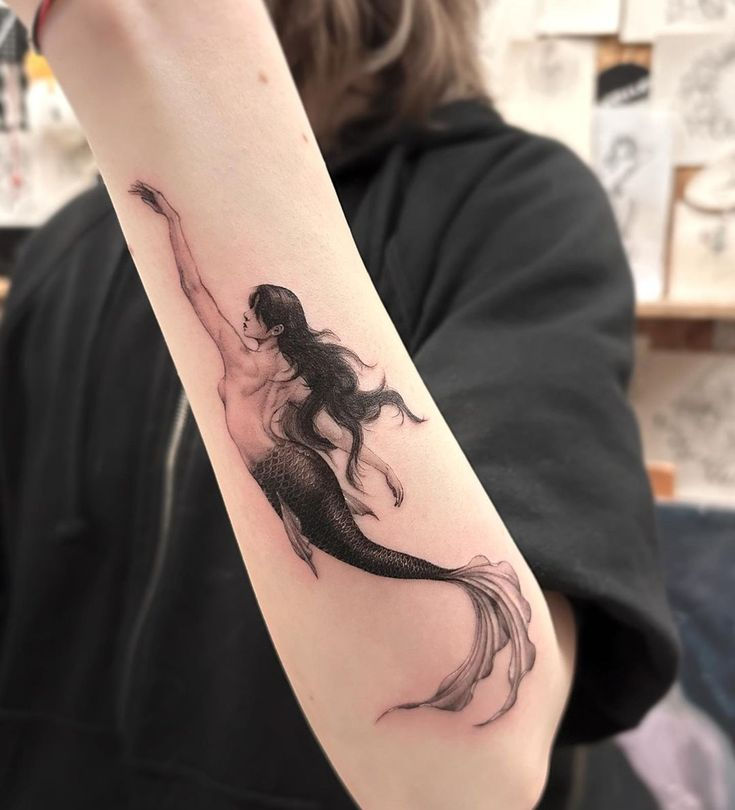


Placement | Best For | Pain (1–10) |
Thigh | Large, detailed designs | 3–5 |
Forearm | Medium pieces, visible | 3–4 |
Back / shoulder blade | Large statement pieces | 4–6 |
Ribs / side | Elongated, dramatic designs | 7–9 |
Calf / leg | Vertical, flowing designs | 4–6 |
Ankle | Small, minimalist | 5–7 |
Placement tip: the thigh and back are the best canvases for detailed mermaid designs — they give the artist room to capture the flowing tail and intricate details. The forearm is great for a visible but professional-friendly medium piece.
5. Pain, Cost & Healing

Pain: Most mermaid placements rate 3–6/10. The ribs and side are the most painful (7–9), while the thigh and forearm are more comfortable.
Cost:
Small (2–4 inches): $200–$500
Medium (4–8 inches): $500–$1.200
Large (8+ inches): $1.200–$3.000+
Most artists charge $150–$300 per hour. A detailed, realistic mermaid with color and shading takes 4–10+ hours depending on size.
Healing: Standard tattoo healing — 2–4 weeks for the surface, full healing 4–6 weeks. Follow proper aftercare to keep the fine details crisp.
6. Mermaid Tattoo Combinations

Mermaids pair beautifully with other ocean and symbolic elements:
Mermaid + waves — the most classic pairing, emphasizing the ocean connection
Mermaid + anchor — grounding the freedom symbol with stability
Mermaid + compass — guidance and the pull of adventure
Mermaid + moon — mystery and the tides
Mermaid + flowers — softness and beauty alongside the wild
Mermaid + ship — the nautical narrative, the journey
🧜♀️ Related guide: Compass Tattoos: Meanings, Designs & Ideas
7. How to Choose the Right Artist
Look for mermaid or aquatic work in their portfolio — not just any tattoos
Check the tails — flowing, dynamic tails are hard to execute; look for clean line work
Ask for healed photos — the design should look crisp after healing, not just fresh
Discuss the style — realism needs a realism specialist; fine-line needs a fine-line artist
Get a consultation — a good artist will discuss placement and design with you
8. Frequently Asked Questions

What does a mermaid tattoo mean?
A mermaid tattoo symbolizes freedom, duality, mystery, and transformation — the pull between two worlds (land and sea, logic and emotion). It can also represent femininity, power, seduction, and embracing your true self.
Where did the mermaid myth come from?
The earliest known mermaid figure is Atargatis, an Assyrian goddess from around 1000 BCE. In Greek mythology, sirens were originally bird-women (per National Geographic), not mermaids — the fish-tail version evolved later.
Are mermaid tattoos feminine?
Traditionally associated with femininity, but mermaid tattoos are gender-neutral in meaning — they're chosen by anyone drawn to the freedom and duality symbolism. The style determines the look, not the meaning.
What is the best placement for a mermaid tattoo?
The thigh and back are best for large, detailed designs. The forearm is great for a medium, visible piece. Choose based on the size and detail of your design.
How much does a mermaid tattoo cost?
A small piece costs $200–$500, a medium piece $500–$1.200, and a large detailed piece $1.200–$3.000+. Cost depends on size, detail, and the artist's specialization.
Does a mermaid tattoo hurt?
Most placements rate 3–6/10. The thigh and forearm are comfortable, while the ribs and side are more painful (7–9/10).
Can I combine a mermaid with other elements?
Yes — mermaids pair beautifully with waves, anchors, compasses, moons, flowers, and ships. These combinations add depth to the symbolism.
9. Conclusion
A mermaid tattoo is a rich, layered symbol of freedom, duality, and transformation — one of the most meaningful and visually striking designs you can choose. Rooted in 3,000 years of mythology (from the Assyrian goddess Atargatis to the sirens of Greek myth), the mermaid carries a depth that few tattoo subjects can match.
Whether you prefer a delicate fine-line piece or a bold neo-traditional statement, the key is to choose a design that reflects your own meaning, place it where it can be seen, and work with an artist who can bring the flowing, dynamic form to life.
10. References & Sources
Britannica — "Mermaid: Definition, Legend, History & Facts." Source
National Geographic — "The Sirens in Ancient Mythology Weren't the Seductresses of Today." Source
Royal Museums Greenwich — "What Is a Mermaid and What Do They Symbolise?" Source
Audubon — "Sirens of Greek Myth Were Bird-Women, Not Mermaids." Source
Wikipedia — "Mermaid" and "Siren (mythology)." Source
✍️ About the Author
Leonardo Pereira, founder of Tatuagem Blog, has been researching and writing about tattoo art and symbolism since 2015. This guide was reviewed against historical and cultural sources (Britannica, National Geographic, Royal Museums Greenwich) and design trends verified in August 2026.
See More: ⤵
Halloween Tattoos: Spooky and Creative Ideas for Ink Enthusiasts
Japanese Tattoo: Exploring the Rich History and Symbolism of Irezumi
Infinity Tattoo Ideas: Endless Inspiration for Your Next Ink
Cat Tattoos: Meanings, Designs, and Ideas for Feline-Inspired Ink
Feather Tattoo: Meanings, Designs, and Ideas for Your Next Ink
Lotus Flower Tattoo: Meanings, Designs, and Ideas for Your Next Ink
Polynesian Tattoo: Unraveling the Meanings and Traditions Behind the Ancient Art
Birth Flower Tattoos: Celebrating Your Birthday with Floral Ink
Forearm Tattoos for Women: Embracing Femininity and Self-Expression
Head Tattoos for Guys: Bold Designs and Crucial Considerations
Forearm Tattoos: Unleashing Your Personal Style on Skin Canvas
Arm Tattoos: Your Ultimate Guide to Inked Sleeves and Beyond


Comments