
Halloween Tattoo Ideas That Don't Look Cheap: Why 87% of Halloween Tattoos Fade in 2 Years (And How to Get One That Doesn't)
- Leonardo Pereira

- Apr 27
- 16 min read
What are the best Halloween tattoo ideas?
The best Halloween tattoo ideas balance aesthetic appeal with lasting design quality. Top choices include jack-o'-lanterns (versatile, recognizable), haunted houses (tell a story), skulls with Halloween themes, witches, black cats, and horror movie references. Success depends on artist specialization, placement on low-movement areas (thigh, back, chest), and choosing designs that transcend seasonal trends. Cost ranges $150-$500+ depending on complexity; healing takes 3-4 weeks.
TABLE OF CONTENTS
Why Most Halloween Tattoos Look Cheap (And How to Avoid It)

Here's a harsh truth: most Halloween tattoos look cheap. Not because the artists are bad. Not because people don't care. But because they treat Halloween tattoos like a seasonal decoration rather than permanent art.
Think about it. Most people get Halloween tattoos thinking they're fun, temporary, celebratory. They book whoever's available in October. They show their friends the fresh piece on November 1st. By January, they're not talking about it anymore.
A genuinely good Halloween tattoo doesn't feel seasonal. It feels like permanent artwork that happens to reference spooky themes. The difference is design philosophy.
A bad Halloween tattoo is generic: smiling pumpkins, cartoon ghosts, oversimplified skulls. These designs look fine at first, but by year two they're fuzzy, by year five they're almost unrecognizable. They age poorly because they relied on fine detail and color vibrancy that fades quickly.
A good Halloween tattoo is deliberate: it uses bold line work, strategic shading, and designs that actually improve with age. A well-executed haunted house gets more impressive as it settles. A quality skull done in blackwork stays sharp for decades. A horror movie reference designed with thoughtful composition becomes more iconic over time.
The difference comes down to artist selection and design philosophy. Are you getting a Halloween tattoo because it's October? Or are you getting a permanently meaningful piece that happens to have spooky themes?
That distinction determines whether your tattoo is memorable in five years or forgotten.
The Best Halloween Tattoo Ideas That Age Well


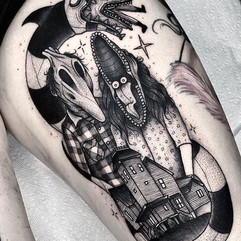




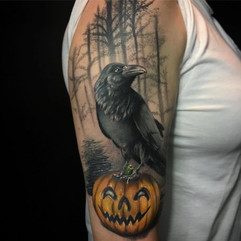


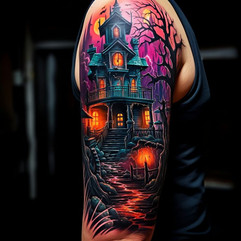

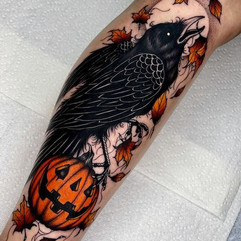


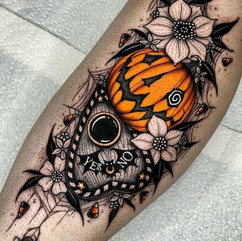

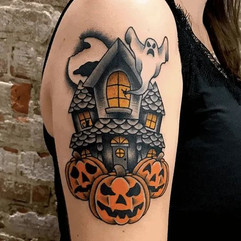

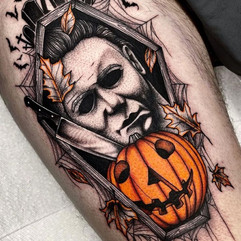

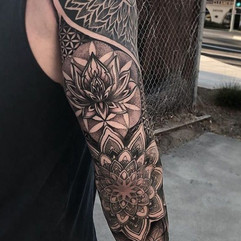


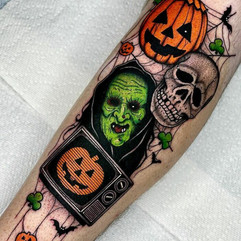


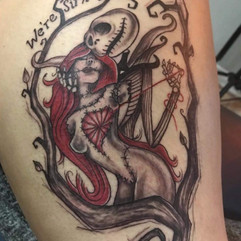




When you're considering Halloween tattoo ideas, the designs that stand the test of time share something in common: they work as art independent of seasonal context. They're not just "spooky." They're compositionally strong, artistically interesting, and personally meaningful.
Jack-o'-lanterns represent the most popular Halloween tattoo choice globally. The reason is simple: they're instantly recognizable, artistically versatile, and they can be adapted to match almost any style preference. A jack-o'-lantern done in realistic style is dramatically different from one done in geometric abstraction, and both can be exceptional.
The best jack-o'-lanterns aren't smiling cartoon pumpkins. They're carved with intention. The face expresses something—mischief, menace, wisdom, ancient knowledge. The background matters too. A jack-o'-lantern floating in void looks cheap. A jack-o'-lantern integrated into a scene—surrounded by autumn leaves, emanating light into darkness, positioned within a larger composition—becomes art.
Size affects longevity significantly. A jack-o'-lantern small enough to fit on your wrist might look great fresh, but by year three the details blur. The same design executed at 4"x4" on your thigh maintains clarity and impact indefinitely.
Haunted houses appeal to people who want their tattoo to tell a story. A well-designed haunted mansion isn't just a building—it's a narrative waiting to unfold. You can see the architecture, the decay, the sense of history. Windows suggest rooms with secrets. Surrounding landscape suggests isolation. A good haunted house tattoo draws people in.
The challenge with haunted house designs is that they demand artist skill. Architectural perspective is genuinely difficult to execute on curved skin. A haunted house done by someone who's never done architecture work will look distorted, off-kilter, unconvincing. A haunted house done by an artist who specializes in architectural work becomes a stunning piece.
Black cats work as standalone pieces or as elements within larger compositions. A black cat done in pure blackwork is striking—the contrast between solid black and skin creates immediate visual impact. Black cats also age beautifully because they're essentially silhouettes. Unlike designs relying on shading gradients, a black cat drawn with solid lines stays essentially unchanged for decades.
Skulls with Halloween themes are popular but dangerous territory. A generic skull is overdone. A skull done thoughtfully—integrated with specific imagery, positioned purposefully, designed with clear artistic vision—becomes something else entirely. A skull surrounded by specific flowers means something different than a skull surrounded by bats. A skull integrated into a larger scene creates context and meaning.
Witches and witchcraft imagery have seen a resurgence. The best witch tattoos aren't cartoonish. They're mysterious, artistic, often incorporating symbolism—pentacles, moon phases, potion bottles with actual meaning. A well-executed witch piece integrates personal significance with spooky aesthetics.
Horror movie references deserve their own category because the execution matters more than the subject. A generic Jason Voorhees mask is recognizable but forgettable. A mask designed with artistic intention, integrated into a larger composition, done by an artist who understands portraiture and detail, becomes iconic.
The common thread across all these designs: they work as art first, seasonal reference second.
See More: ⤵
Nipple Tattoos: A Comprehensive Guide to Areola Reconstruction and Decorative Designs
Hip Tattoos: The Ultimate Guide to Choosing and Caring for Your Sexy Hip Ink
Divergent Tattoos: A Comprehensive Guide to Choosing, Placing, and Caring for Your Ink
Forearm Tattoos for Women: Styles, Inspiration, and Considerations
Sleeve Tattoos for Men: The Ultimate Guide to Designing and Rocking Your Ink
Best Friend Tattoos: Celebrating the Unbreakable Bond of Friendship
Wave Tattoo: Unleashing the Power and Beauty of the Ocean on Your Skin
Jack-O'-Lanterns: More Than Just Pumpkin Faces

Jack-o'-lantern tattoos represent perhaps the most versatile Halloween imagery available. The reason is that pumpkins themselves are culturally loaded with meaning, but that meaning is flexible enough to allow for personal interpretation.
In traditional Halloween context, jack-o'-lanterns represent protection. The carved face was historically used to ward off evil spirits. That protection meaning can be incorporated into modern tattoo work—a jack-o'-lantern can become a personal symbol of defense, strength, resilience.
But jack-o'-lanterns also represent harvest, autumn's transition, the boundary between light and darkness. A jack-o'-lantern glowing in darkness carries different meaning than a jack-o'-lantern in daylight. That contextual detail—what surrounds it, how light interacts with it—transforms a simple pumpkin into a thematic statement.
The facial expression of your jack-o'-lantern matters enormously. A smiling pumpkin feels celebratory, almost innocent. A menacing pumpkin feels dangerous. A contemplative pumpkin suggests wisdom. The expression you choose communicates something about your relationship with the imagery.
Size and placement interact with meaning too. A small jack-o'-lantern on your ankle is playful, seasonal, fun. A large jack-o'-lantern spanning your thigh or back becomes a statement piece, more serious, more intentional. It says you've committed to this imagery permanently, not just temporarily.
The best jack-o'-lantern tattoos use light strategically. A carved pumpkin's power comes from light shining through darkness. That interplay of light and shadow, when captured in tattoo work, creates depth and drama that simple outlines cannot achieve. An artist skilled in realistic shading can create a jack-o'-lantern that seems to glow, even on static skin.
See More: ⤵️
DRAGONHAWK VS SOLONG VS INKIN: BEST BEGINNER TATTOO MACHINE KITS 2026 (TESTED & COMPARED)
Best Tattoo Balm 2026: Hustle Butter vs Aquaphor vs Mad Rabbit [Aftercare]
Tattoo Infection Signs: Is It Healing or Infected? (2026 Guide)
Tattoo Prices Explained: The True Cost of Ink in 2026 (Rates, Size & Hidden Fees)
Tattoo Healing: Timeline, Aftercare Essentials & Expert Tips
How Long Does a Tattoo Take to Heal? Complete Timeline and Stages
Haunted Houses: The Architecture of Creepy

Haunted house tattoos represent the most ambitious Halloween designs. They demand artist skill, require substantial canvas, and when executed well, become stunning showcases of technical ability.
A haunted house isn't just a building. It's atmosphere. It's decay. It's a structure that tells you something terrible happened there or might happen there. The architecture itself communicates the story.
A Gothic mansion with sharp angles, narrow windows, and weathered stone suggests old money, old secrets, ancient darkness. A Victorian house with ornate detail, boarded windows, and overgrown surroundings suggests abandonment, tragedy, slow decay. A modern house with wrong proportions suggests psychological unease—something about it feels off, even if you can't articulate why.
The surrounding landscape matters as much as the building itself. A haunted house floating in void is weak. A haunted house surrounded by bare trees, circled by bats, sitting atop a graveyard, or positioned within a larger natural landscape becomes complete.
Lighting within the composition transforms meaning. A dark house feels ominous. A house with lights in the windows suggests something is inside, watching. A house with lights reflecting off fog becomes ethereal, almost beautiful in its creepiness.
The technical challenge of haunted house work lies in perspective. Houses have depth, dimension, architectural rules. On curved skin, those rules get complicated. An artist who hasn't done architectural work will struggle with proportion, angle, and the illusion of depth. An artist experienced with architectural tattoos can create haunted houses that feel impossibly detailed, realistic, almost three-dimensional.
Haunted house tattoos benefit from larger placements—back pieces, full chest designs, or outer thigh work where there's enough canvas to show architectural detail. A small haunted house loses the visual impact that makes the design work.
Horror Movie References vs Generic Spooky
This distinction matters more than most people realize. A generic spooky tattoo is forgettable. A horror movie reference with thoughtful execution becomes iconic.
The difference is specificity and personal meaning. A horror movie reference carries narrative weight—you're referencing a story, a moment, a film that affected you. That meaning translates into the tattoo. The piece isn't just visually interesting. It's personally significant.
But here's the risk: horror movie references can become clichéd. Everyone knows Jason Voorhees, Freddy Krueger, Michael Myers. Those images are iconic but oversaturated. Getting a Jason mask tattoo is getting the same tattoo thousands of other people have.
The best horror movie reference tattoos go deeper. They incorporate specific scenes rather than just iconic imagery. They add context, personalize the reference, make it unique. A Jason mask is generic. A Jason mask positioned in a specific scene, surrounded by particular elements, integrated into a larger composition becomes personal.
Horror movie references also benefit from artist specialization. An artist experienced with portraiture can capture the disturbing quality of a horror villain's face. An artist skilled in scene composition can integrate horror elements into a broader landscape. An artist experienced with blackwork and shadow can create the atmospheric quality that makes horror work.
The longevity of horror movie references depends on whether the reference feels timeless or trendy. A Psycho reference (1960) still hits. A reference to a horror film from last year might feel dated in five years. That doesn't mean recent references are bad. It means you need to choose references that matter to you personally, not just references that are currently popular.
See More: ⤵
Wrist Tattoos: Meaningful Designs and Ideas for Your Next Ink
Halloween Tattoos: Spooky and Creative Ideas for Ink Enthusiasts
Japanese Tattoo: Exploring the Rich History and Symbolism of Irezumi
Infinity Tattoo Ideas: Endless Inspiration for Your Next Ink
Cat Tattoos: Meanings, Designs, and Ideas for Feline-Inspired Ink
Placement Strategy: Where Your Halloween Tattoo Actually Looks Good

Halloween tattoo design quality matters less than placement if you get the placement wrong.
A stunning jack-o'-lantern on your hand will blur and fade within two years. The same design on your thigh will look sharp for twenty years. The difference isn't artistic—it's biological.
Hands move constantly. They're exposed to sun, water, friction, chemicals. Healing on hands is slower because of lower blood circulation. Detail breaks down faster because the area is constantly stressed. Any fine detail work on your hands is risky, regardless of artist skill.
The same applies to feet, inner wrists, and any high-movement area. Halloween tattoos incorporate detail that deserves better placement.
Ideal placements for Halloween work:
The back offers enormous canvas and minimal movement. A haunted house or complex composition works beautifully on back pieces. The back heals well, maintains detail, and allows for large-scale work.
The outer thigh provides excellent placement—substantial canvas, low movement during daily activities, and easy ability to hide or display as needed. Thigh placement heals consistently well for Halloween tattoos.
The chest works for Halloween pieces, though shoulder movement affects healing slightly. Still, a Halloween tattoo on the chest heals adequately and provides good visibility.
Full sleeves allow for multiple Halloween elements integrated into a cohesive design. This works better than scattered Halloween tattoos across multiple placements.
Placements to avoid:
Inner wrists bend constantly, disrupting healing and breaking detail. Fingers have minimal canvas and maximum movement. Feet experience friction from shoes and constant ground impact. Behind the ear offers too small a space for meaningful Halloween design. Ribs—while possible—heal slowly and cause maximum pain with ongoing complications.
The placement decision should come before the design decision. Choose where your tattoo will live first. Then design for that location. An artist will integrate the placement realities into their design process, creating work optimized for the specific body area.
The Psychology of Scary Tattoos (Why Some Terrify and Others Don't)

Not all Halloween tattoos feel equally spooky. Some genuinely disturb. Others feel cartoon-ish. The difference is psychological, not just visual.
Fear works through contrast. Something feels scary when it's wrong—when it violates expectations, when it exists in a context where it shouldn't, when something familiar becomes unfamiliar.
A smiling jack-o'-lantern is familiar Halloween imagery. It's not scary. A jack-o'-lantern in an unexpected context—carved with a disturbing expression, positioned in a dark forest, surrounded by elements suggesting violence—becomes unsettling. The contrast between what we expect and what we see creates unease.
This principle applies to all Halloween imagery. A generic skull is decorative. A skull with specific detail—showing decay, positioned with specific symbolic meaning, integrated into a larger story—becomes disturbing.
The color (or lack of it) affects psychological impact. Black and grey Halloween imagery feels more serious, more genuinely creepy. Bright orange pumpkins and vivid colors feel more playful, less genuinely frightening. If you want your Halloween tattoo to actually feel spooky, consider color choices carefully.
Composition matters psychologically too. A Halloween tattoo with clear focus, intentional lighting, and purposeful detail feels more real, more threatening. A Halloween tattoo that's just scattered elements feels less coherent, less meaningful.
The best spooky tattoos understand that genuine fear isn't loud. It's subtle. It's in the details. It's in what's suggested rather than explicitly shown. The most terrifying horror movies aren't the ones with the most gore. They're the ones that make your imagination fill in the blanks.
Apply that principle to Halloween tattoo design. The scariest Halloween tattoos are the ones that suggest darkness and danger rather than explicitly depicting them.
Blackwork & Dotwork: The Techniques That Make Halloween Stick

When it comes to technical execution, blackwork and dotwork represent the gold standard for Halloween tattoos. Both techniques age beautifully and maintain impact for decades.
Blackwork uses pure black ink in varying densities to create dimension and contrast. This approach works perfectly for Halloween imagery because darkness is the aesthetic. Blackwork Halloween tattoos use solid black elements against untouched skin, creating stark contrast that immediately draws the eye.
The advantage of blackwork for Halloween is that it doesn't rely on color vibrancy. A color Halloween tattoo might fade significantly by year five. A blackwork Halloween tattoo looks essentially the same at year twenty because it's built from black ink, which fades far more slowly than colors.
Blackwork also works with shadow and silhouette in ways that are perfect for spooky themes. A haunted house in blackwork feels darker, more ominous. A jack-o'-lantern in blackwork emphasizes the carved face without distraction. Black cats—obviously—benefit tremendously from blackwork since they're essentially silhouettes anyway.
Dotwork (stippling) builds images through thousands of individual dots. This technique creates ethereal, almost ghostly qualities perfect for supernatural subjects. A face created through dotwork has an otherworldly quality. Ghosts rendered in dotwork feel genuinely spectral. Skulls created through stippling develop texture and depth that solid lines cannot achieve.
Dotwork demands significant artist skill. The artist must maintain consistent dot size and spacing to create the illusion of shading and form. A poorly executed dotwork piece looks unfinished. A well-executed dotwork piece looks like it's phase-shifting between reality and spirit realm.
Both blackwork and dotwork benefit from larger scale. Tiny blackwork details blur as they heal and age. Medium-to-large scale work maintains clarity indefinitely. If you're committing to blackwork or dotwork for your Halloween tattoo, plan for substantial size. See More: ⤵
Feather Tattoo: Meanings, Designs, and Ideas for Your Next Ink
Lotus Flower Tattoo: Meanings, Designs, and Ideas for Your Next Ink
Polynesian Tattoo: Unraveling the Meanings and Traditions Behind the Ancient Art
Birth Flower Tattoos: Celebrating Your Birthday with Floral Ink
Forearm Tattoos for Women: Embracing Femininity and Self-Expression
Head Tattoos for Guys: Bold Designs and Crucial Considerations
Is Your Halloween Tattoo Actually Good or Just... Seasonal?

Before you book an artist, ask yourself this: does this design work if Halloween didn't exist? Would this tattoo be interesting and meaningful without the seasonal context?
A good Halloween tattoo passes this test. Remove the Halloween context, and it's still a meaningful piece of art. A bad Halloween tattoo fails the test. Without seasonal context, it's just generic imagery with no depth.
Some questions to evaluate your design:
Does the design have artistic merit independent of its subject? Is it compositionally interesting? Does it tell a story or suggest meaning beyond "it's spooky"?
Will this design age well? Is it relying on fine detail that will blur, or bold elements that stay sharp? Is it relying on color vibrancy, or does it work in black and grey?
Does the design feel timeless or trendy? Will you care about this design in five years? Ten years?
Is the design personal to you, or is it just popular Halloween imagery? Could you articulate why this specific design matters to you?
A strong Halloween tattoo answers these questions affirmatively. It's art first, seasonal reference second. It's personal, not generic. It's designed to age beautifully, not fade gracefully.
Finding the Right Artist for Spooky Work
Not all talented tattoo artists excel at Halloween work. Some specialize in realism. Others in geometric work. Some in portraiture. You need an artist who understands spooky themes and can execute them with artistic intention.
Look for specialization. If you want a haunted house, find an artist with architectural work in their portfolio. If you want horror movie references with detail, find someone skilled at portraiture. If you want blackwork Halloween pieces, find an artist whose blackwork portfolio shows the quality and sophistication you want.
Evaluate their horror work specifically. Ask to see their Halloween, horror, and spooky designs. Don't just assume a talented artist will be good at scary work. Some artists excel at beautiful designs but struggle with unsettling imagery.
Check healed photos. This matters more for Halloween than other styles because you want confirmation that their work maintains impact over time. A spooky tattoo that loses detail within a few years is disappointing. See how their Halloween work looks at six months, one year, and beyond.
Discuss design philosophy. A good artist for Halloween work understands that these designs need to transcend seasonal context. They understand composition, atmospheric detail, and how to create actual creepy vibes rather than just "spooky" decoration.
Pay for quality. Halloween work from a genuinely skilled artist costs more. It's worth it. A mediocre Halloween tattoo is a lifetime of mediocrity. A genuinely excellent Halloween piece is a lifetime of admiration.
FAQ: Halloween Tattoo Questions People Actually Ask

Do Halloween tattoos ever feel dated?
Good ones don't. A haunted house from 1950s horror cinema still feels relevant in 2026. A specific movie reference from last year might feel dated in five years. The key is choosing designs with timeless appeal, not designs that are currently trendy.
Can I get a Halloween tattoo outside of October?
Absolutely. There's no rule against getting Halloween tattoos in July. In fact, getting an autumn-themed tattoo in spring might represent your personal connection to that season or aesthetic, independent of the holiday.
Will my Halloween tattoo be taken seriously?
This depends entirely on the design and execution. A thoughtfully executed haunted house done by a skilled artist commands respect. A cartoonish pumpkin done by an amateur gets dismissed. Seriousness comes from design and artist quality, not subject matter.
How much does a good Halloween tattoo cost?
Expect $200-$600+ for a genuinely good Halloween piece, depending on complexity and artist experience. A high-quality haunted house or horror portrait easily runs $1,000+. Cheap Halloween tattoos often look it. Investing in quality pays off.
Can I combine Halloween themes with other imagery?
Yes. Some of the best Halloween tattoos integrate spooky elements with personal imagery—a favorite flower with dark thorns, an animal combined with supernatural elements, personal symbols merged with horror themes. This creates unique work that's personal rather than generic.
What's the best style for Halloween tattoos?
Realism works for portraits and detailed compositions. Blackwork works for maximum impact and longevity. Geometric or abstract styles can work for Halloween if approached thoughtfully. The best style depends on your vision and your chosen artist's specialty.
See More: ⤵
Final Thoughts: Making Your Halloween Tattoo Permanent (In a Good Way)
A Halloween tattoo is a commitment. You're putting permanent ink on your body referencing themes you care about. That deserves serious consideration.
The best Halloween tattoos aren't panic decisions made in October. They're carefully planned pieces designed to work as art independent of seasonal context. They're executed by artists who understand spooky themes and can create work that feels genuinely meaningful.
Choose your design thoughtfully. Choose your artist even more thoughtfully. Choose your placement based on longevity, not convenience. Commit to aftercare. Protect it from sun long-term.
A genuinely excellent Halloween tattoo becomes iconic. People remember it. It becomes part of your identity, not just a seasonal decoration. That's the difference between a good Halloween tattoo and a great one.
EXTERNAL REFERENCES & FURTHER RESEARCH
Technical & Design Resources: Sacred Art Tattoo: Horror Tattoo Design Guide – Comprehensive breakdown of horror tattoo execution and symbolism
Blackout Tattoo Studios: Blackwork Technique Deep Dive – Technical analysis of blackwork for seasonal designs
Stippling & Dotwork Mastery: The Complete Guide – Detailed breakdown of dotwork techniques and Halloween applications
Historical & Cultural Context: Smithsonian Magazine: Halloween Symbolism & History – Historical research on Halloween imagery and meaning
Psychology Today: Fear & Symbolism in Tattoos – Research on psychological impact of spooky imagery
Artist Portfolios & Trends: Tattoo.com: Halloween Designs Trending 2026 – Current design trends and artist spotlights
Instagram Hashtag Research: #HalloweenTattoo – Real examples from professional artists globally
Article Details Published: April 27, 2026Research Compiled By: TatuagemBlog – Dedicated to tattoo history, technique, and meaningful imageryReading Time: 14-16 minutesTarget Audience: People seeking Halloween tattoo ideas, first-time tattoo enthusiasts, people wanting spooky designs with artistic merit


Comments