
Dream Catcher Tattoos: Meaning, Culture, and Design (2026 Edition)
- Leonardo Pereira

- Dec 6, 2025
- 10 min read
Updated: Dec 10, 2025
I still remember walking into a tattoo shop in Denver a few years ago and seeing a young woman arguing with an artist. She wanted a dream catcher tattoo, but she wanted to remove the "web" because she "didn't like spiders." The artist, rightfully, refused. He explained that without the web, it wasn't a dream catcher—it was just a hoop with feathers.
That moment stuck with me. It highlighted a massive gap between the aesthetic of the dream catcher and its sacred origin.
If you are reading this, you are likely drawn to the beauty of the dream catcher—the intricate weaving, the flowing feathers, the mystical vibe. It is one of the most popular tattoos in the US for a reason. But it is also one of the most controversial.
In this guide, I’m going to help you navigate that line. We will explore how to get a Dream Catcher tattoo that is not only visually stunning but also culturally respectful. We will dive into the Ojibwe origins, the specific meanings of the beads and feathers, and the 2025 trends that are modernizing this ancient talisman.
Whether you want a massive thigh piece or a delicate watercolor design behind your ear, this is your roadmap.
Table of Contents
1. The Elephant in the Room: Cultural Appropriation vs. Appreciation
Before we look at designs, we have to address the most common question I see online: "Is getting a dream catcher tattoo offensive?"
The short answer: It depends on your intent and your knowledge.
The dream catcher (or asabikeshiinh) originates specifically from the Ojibwe (Chippewa) people, though it was adopted by other tribes during the Pan-Indian movement of the 1960s and 70s. For Indigenous people, this is a protective talisman, not just "boho decor."
How to do it respectfully:
Educate Yourself: Know the history (which you are doing right now!).
Avoid Stereotypes: Do not mix it with generic "Indian" imagery like headdresses or sexualized "squaw" figures. That is where it crosses the line into offensive appropriation.
Respect the Anatomy: Keep the web. The web is the filter. Without it, the symbol loses its function.
Support Indigenous Artists: If you can, find an Indigenous tattoo artist to do the piece. It adds a layer of authenticity and respect to the exchange.
2. Origin Story: The Legend of the Spider Woman

To truly appreciate your tattoo, you need to know the story behind it.
In Ojibwe legend, the Spider Woman (Asibikaashi) took care of the children and the people of the land. As the Ojibwe nation spread to the corners of North America, it became difficult for Asibikaashi to reach all the children. So, the mothers and grandmothers began weaving magical webs for the children, using willow hoops and sinew.
The Function: The dream catcher acts as a filter for the night air.
Good dreams know the way; they pass through the center hole and slide down the feathers to the sleeping person.
Bad dreams get tangled in the web and perish when the first light of the morning sun hits them.
When you get this tattoo, you are essentially marking your body with a permanent filter for negativity.
2.1 The Tale of Two Tribes: Ojibwe vs. Lakota Legends
While I touched on the Spider Woman (Asibikaashi) of the Ojibwe tradition, it is crucial to understand that the Lakota people also have a dream catcher legend—but with a twist. This distinction is something most generic tattoo articles miss, and knowing it gives your tattoo a deeper narrative.
In the Lakota version, a spiritual leader had a vision of Iktomi, a trickster spirit who appeared as a spider. Unlike the Ojibwe legend where the web catches the bad dreams, Iktomi spun a web to catch the good ideas and visions, letting the bad ones fall through the hole in the center.
Why this matters for your tattoo:
The Ojibwe Style: Focuses on protection and filtering out harm. (Web catches bad).
The Lakota Style: Focuses on capturing wisdom and good opportunities. (Web catches good).
When you explain your tattoo to someone, are you protecting yourself from nightmares (Ojibwe), or are you trying to hold onto your good ideas (Lakota)? Choosing your narrative adds a layer of personal intent to the ink.
3. Deconstructing the Design: What Each Part Means


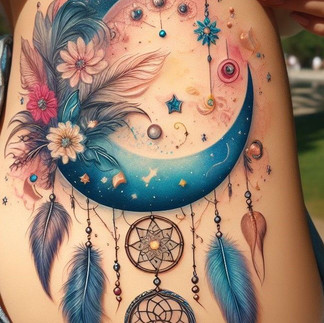



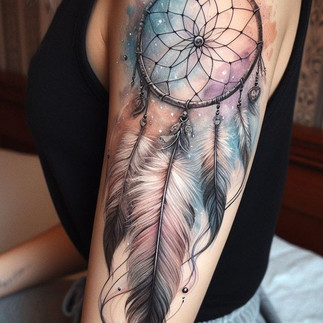

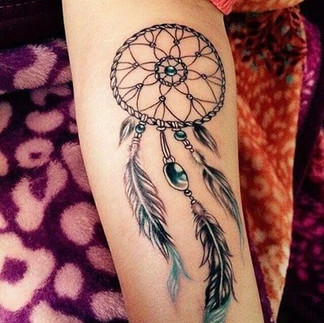





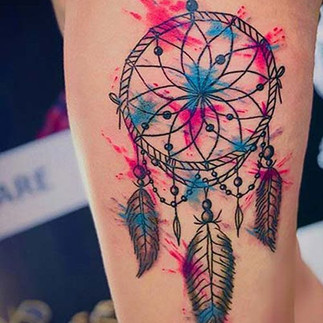




A dream catcher isn't just a random assortment of items. Every element has a job. When designing your tattoo, make sure you include these elements to keep the symbolism intact.
Element | Symbolism | Tattoo Design Tip |
The Hoop (Circle) | The Circle of Life; the sun and moon traveling across the sky. | Keep it perfectly round. Broken hoops symbolize a broken cycle. |
The Web | The filter. It catches the bad energy/dreams. | Ensure your artist has steady hands for fine lines. The geometry must be precise. |
The Center Hole | The passage. It allows good dreams to enter. | Do not fill the center completely; leave negative space. |
Feathers | The ladder. They allow good dreams to glide down gently. | Use Eagle feathers for strength (men) or Owl feathers for wisdom (women), traditionally. |
Beads/Gemstones | The Spider (the weaver) OR bad dreams that were caught. | A single gemstone represents the creator (the spider). |
3.1 The Numerology of the Web: Points Matter
Most people just ask their artist for "a web." But did you know the number of points where the web touches the hoop changes the meaning entirely? I always advise my clients to count the points in the stencil before the needle touches the skin.
5 Points: Represents the star shape and the five elements (Earth, Air, Fire, Water, Spirit).
6 Points: Represents the Eagle (courage).
7 Points: The most traditional number. It represents the Seven Grandfather Teachings (Wisdom, Love, Respect, Bravery, Honesty, Humility, and Truth) and the seven prophecies.
8 Points: Represents the Spider Woman herself (8 legs). This is a powerful tribute to the protector.
13 Points: Represents the 13 phases of the moon in a year. Perfect for those aligning their tattoo with lunar cycles or feminine energy.
Pro Tip: If you are getting a small tattoo (wrist or ankle), stick to fewer points (5 or 6). Trying to cram 13 points into a 2-inch tattoo will result in a muddy blob of ink in five years.
3.2 Feathers & Beads: Decoding the Details

The type of feather you choose changes the "energy" of the tattoo. In traditional culture, feathers were earned, not just found. While you can't replicate that in a tattoo, you can honor the symbolism.
The Feather Dictionary:
Eagle Feather: Represents courage, strength, and connection to the divine. Traditionally masculine.
Owl Feather: Represents wisdom, intuition, and seeing in the dark. Traditionally feminine.
Hawk Feather: Represents insight and guardianship.
Peacock Feather (Modern Twist): Represents immortality and resurrection. A popular choice for 2025 "Neo-Traditional" designs, adding a splash of teal and purple.
The Color of the Beads: Don't just pick your favorite color. Pick a mood.
Turquoise: Healing and protection (very traditional).
Red: Passion and vitality.
Black: Grounding and authority.
White: Purity and clarity of thought.
4. 2025 Design Trends: From Watercolor to Micro-Realism
The classic black-and-grey dream catcher is timeless, but 2025 is bringing some incredible new styles to the US market.
1. The "Micro-Realism" Approach
Instead of bold outlines, artists are using single needles to create hyper-realistic feathers and beads. The web looks like actual silk thread.
Best for: Forearm, Wrist.
Vibe: Sophisticated, delicate, modern.
2. Watercolor Fusion
This is arguably the most popular style for dream catchers right now. The outline is black ink, but the background is a splash of chaotic watercolor (blues, purples, pinks) representing the "dream world."
Best for: Thigh, Ribs, Back.
Vibe: Artistic, dreamy, emotional.
3. The "Wolf & Moon" Hybrid
Combining the dream catcher with a wolf or a crescent moon is a huge trend. The wolf adds a layer of guardianship and loyalty, while the moon emphasizes the nighttime/dream aspect.
Note: Be careful here. Ensure the wolf is rendered realistically and respectfully, avoiding "gas station t-shirt" aesthetics.
4. Geometric/Mandala Integration
Replacing the traditional web with a precise Mandala pattern. This mixes Eastern sacred geometry with the Western Native symbol. It’s visually stunning and very complex.
5. Placement Guide: Where Should You Put It?
The shape of a dream catcher (round top, dangling bottom) dictates where it looks best. It needs to flow with the body's natural curves.
The Thigh (The "Boho" Classic)
Why: It provides a large, flat canvas. The feathers can wrap around the leg naturally.
Visibility: Easy to hide for work, easy to show off in shorts.
Pain: 4/10 (Outer thigh is easy; inner thigh is spicy).
The Upper Back / Nape
Why: Perfect symmetry. The hoop sits on the spine/neck, and feathers drape down the back.
Visibility: Low.
Pain: 6/10 (Spine can be sharp).
The Ribs / Side
Why: Extremely intimate and feminine placement. It moves when you breathe.
Visibility: Hidden.
Pain: 9/10 (This is the "pain cave." Only for the brave).
Behind the Ear
Why: For tiny, micro-dream catchers.
Visibility: High (unless you have long hair).
Pain: 5/10 (Annoying vibration, but quick).
6. Pain Chart & Healing Expectations
Let’s be real about the pain. A dream catcher tattoo usually involves a lot of linework (the web) and shading (the feathers).
Linework: Feels like a hot cat scratch. It’s sharp and stinging.
Shading: Feels like a dull, vibrating burn.
Healing Timeline:
Days 1-3: Redness, oozing, soreness. Keep it covered with Saniderm if possible.
Days 4-7: The "Itch Phase." It will peel like a sunburn. DO NOT SCRATCH.
Days 8-14: The skin looks shiny/milky. It is healing underneath.
Day 30: Fully settled.
7. US Pricing Guide (2025 Estimates)
How much should you budget? In the US, you get what you pay for. Do not bargain hunt for a symbol that requires perfect circles and straight lines.
Shop Minimum: $100 - $150 (covers setup).
Small (Wrist/Behind Ear): $150 - $250.
Medium (Forearm/Calf): $350 - $600.
Large (Thigh/Back Piece): $800 - $1,500+.
Note: Watercolor styles often cost more because they take longer to blend.
8. FAQ: Common Doubts Answered
Q: Can I put a name in the dream catcher? A: Yes. Many parents put their children’s names in the hoop or woven into the feathers. It symbolizes protecting that person from harm.
Q: Does the color of the beads matter? A: Traditionally, yes.
White: Wisdom/Purity.
Red: Life/Health.
Black: Strength/Authority.
Blue: Spirit/Father Sky.
Q: Will the feathers fade? A: Feathers require soft shading (gradients). Without a solid black outline, they can fade faster than other tattoos. Ask your artist for "high contrast" to ensure longevity.
Q: Is it bad luck to buy a dream catcher for yourself? A: In tradition, they are usually given as gifts. However, for a tattoo, you are the creator of your own protection. It is not bad luck; it is self-care.
9. Conclusion
A Dream Catcher tattoo is a beautiful commitment to protecting your peace. It serves as a daily reminder to filter out the negativity—whether that’s bad dreams, toxic people, or your own self-doubt—and let the good flow through.
If you choose to get this ink, wear it with the dignity it deserves. Respect the culture, choose an artist who understands the geometry, and let it be a symbol of your own spiritual safety net.
Ready to filter your dreams? Start looking for artists who specialize in "fine line" or "neo-traditional" styles today.
Disclaimer: I am a tattoo enthusiast and writer. Always consult with a professional tattoo artist for specific advice on placement and design suitability for your skin type.
Final Thoughts: Your Permanent Talisman
A dream catcher tattoo is a commitment. It is a commitment to the culture it comes from, a commitment to the meaning you assign to it, and a commitment to the care of your own skin.
In a world that is increasingly chaotic, carrying a permanent filter for negativity on your skin is a powerful choice. Whether you believe in the spiritual legend of the Spider Woman or simply find peace in the aesthetic of the woven web, this tattoo marks you as a dreamer.
Don't rush the process. Count the points on the web. Choose your feathers with intent. And most importantly, wear it with the respect it demands.
Now, go find an artist who can weave a web worthy of your dreams.
See More: ⤵
Nipple Tattoos: A Comprehensive Guide to Areola Reconstruction and Decorative Designs
Hip Tattoos: The Ultimate Guide to Choosing and Caring for Your Sexy Hip Ink
Divergent Tattoos: A Comprehensive Guide to Choosing, Placing, and Caring for Your Ink
Forearm Tattoos for Women: Styles, Inspiration, and Considerations
Sleeve Tattoos for Men: The Ultimate Guide to Designing and Rocking Your Ink
Best Friend Tattoos: Celebrating the Unbreakable Bond of Friendship
Wave Tattoo: Unleashing the Power and Beauty of the Ocean on Your Skin
Wrist Tattoos: Meaningful Designs and Ideas for Your Next Ink
Halloween Tattoos: Spooky and Creative Ideas for Ink Enthusiasts
Japanese Tattoo: Exploring the Rich History and Symbolism of Irezumi
Infinity Tattoo Ideas: Endless Inspiration for Your Next Ink
Cat Tattoos: Meanings, Designs, and Ideas for Feline-Inspired Ink
Feather Tattoo: Meanings, Designs, and Ideas for Your Next Ink
Lotus Flower Tattoo: Meanings, Designs, and Ideas for Your Next Ink
Polynesian Tattoo: Unraveling the Meanings and Traditions Behind the Ancient Art
Birth Flower Tattoos: Celebrating Your Birthday with Floral Ink
Forearm Tattoos for Women: Embracing Femininity and Self-Expression
Head Tattoos for Guys: Bold Designs and Crucial Considerations
Forearm Tattoos: Unleashing Your Personal Style on Skin Canvas
Arm Tattoos: Your Ultimate Guide to Inked Sleeves and Beyond
Phoenix Tattoo: Rising from the Ashes with Stunning Design Ideas
Heart Tattoo: Meanings, Designs, and Ideas for Your Next Ink


Comments