
Memorial Tattoos: 40+ Heartfelt Design Ideas, Placement & Care
- Leonardo Pereira

- May 6
- 11 min read
Updated: 5 days ago
HERE'S THE THING ABOUT MEMORIAL TATTOOS
You're thinking about getting inked to honor someone you lost. That's real. That's meaningful. But here's what nobody tells you: the worst time to get a memorial tattoo is right after they die.
I know that sounds brutal. But it's the truth.
Most people get memorial tattoos in a fog. Grief is fresh. Everything feels urgent. You want to do something now to make it feel less empty. So you book an artist, you sit down, and three hours later you've got their face on your chest or their name on your wrist.
Sometimes that works out. But a lot of times? You regret it.
Not because the tattoo itself is bad. But because you made the decision when your brain wasn't thinking clearly. When shock was still running the show. When grief felt like it would feel that way forever.
This guide isn't about talking you out of a memorial tattoo. It's about giving you the framework to actually make the decision well. When you're ready emotionally. When you know what design matters. When you've picked an artist who actually understands grief.
THE ACTUAL TIMELINE: WHEN YOU'RE READY (REAL TALK)

Let's be honest about this.
Right now (Week 1-2): You're in shock. Your brain isn't processing anything. Everything feels surreal. You might feel like you need to do something immediately. That's grief talking, not clarity talking. Don't book yet. I'm serious.
Few weeks in (Weeks 3-6): Now grief is hitting different. It's raw. You're thinking about them constantly. The urge to memorialize them is strong—stronger than it was in week one. But you're still in the thick of it emotionally. Your decisions are still reactive, not thoughtful. Wait a bit more. Give it one more month.
Two to four months in: This is the sweet spot for most people. Shock has worn off. You're not in the raw phase anymore. You're starting to think clearly about what you actually want. You know what design would mean something. You've had time to research artists. You could get a memorial tattoo now and be genuinely happy with it.
Six months to a year: If you've waited this long, you're probably ready. Grief has become part of your life instead of the only thing in your life. You're thinking about them with some peace now, not just pain. The tattoo you get at this point? It's usually something you'll love forever.
More than a year: There's no rush anymore. That's actually freedom. You can get exactly what you want without the time pressure.
Real talk: Getting a memorial tattoo immediately can work for some people. The physical pain can help process emotional pain. But most people tell me after a year that they wish they'd waited a few months. That they would've chosen something different. Or that they would've picked a better artist.
So if you're thinking about this in the first week? Put the phone down. Give yourself time.
WHERE YOU PUT IT ACTUALLY MATTERS (AND NOT FOR THE REASON YOU THINK)

This isn't about aesthetics. It's about what the placement says about your grief.
Over your heart (chest): This is where most people put memorial tattoos. It's the obvious choice. Close to your heart. Intimate. But here's the thing—chest tattoos hurt more because of the bone proximity. And healing is slower because your chest moves with every breath. If you go here, you're saying something: you want it private, but you want it close. You're carrying them with you at all times.
Pain level: Yeah, it's going to be 8-9/10. Bone's right there. Healing takes longer too. Worth it if you're committed.
Upper arm: This is the balanced move. You can show it when you want. Hide it when you want. Healing is fast—good blood flow, minimal friction from clothing. It's visible but not aggressively visible. You're saying: "I'm keeping this, but I'm not forcing people to see it." Most people I know with memorial tattoos go here.
Pain level: 4-5/10. Totally manageable. Heals in about 4 weeks. Sweet spot if you want flexibility.
Wrist: You're making a statement here. It's always visible. You don't get to hide it. People will ask. But every time you look at your hand, you see them. That's intentional. That's powerful.
Pain level: 6-7/10 (bone proximity). Healing is slower (constant movement). But it's a small area, so sessions are quick.
Inner forearm: You can roll up your sleeve and show it, or keep it covered with a long-sleeve shirt. It's one of the more versatile placements. You're not hiding, but you're not forcing it either.
Pain level: 5-6/10. Manageable. Medium healing time.
Thigh: Private. Nobody sees it unless you want them to. You're the only one carrying them around in that way. It's intimate in a different way—just for you.
Pain level: 3-5/10 (fatty tissue, easiest pain-wise). Heals the fastest too.
The real strategy: Don't pick placement based on what looks cool. Pick it based on your grief style. Do you need constant visual reminder? Do you need privacy? Do you want people to ask about it? That determines placement more than anything.
WHAT THIS ACTUALLY COSTS

Let's be real about money.
A simple name and date? $150-$400. Artist's gonna spend maybe 45 minutes on it. Quick lettering, clean lines.
Their handwriting tattooed on you? $300-$800. More complex because you're working with actual handwriting—not a font. Takes 1-2 hours. But it's deeply personal. Only them, in their actual style.
A symbol—heart, angel wings, whatever—that's $200-$600 depending on complexity. Quick designs usually.
A portrait of them? That's where it gets real. A small portrait from a good artist? $500-$1,500. Medium size? $1,200-$2,500. If you want actual quality—artist who can capture their likeness—you're spending real money. And you should.
Here's the thing: don't cheap out on memorial tattoos. A $150 portrait from a hack artist is worse than no tattoo. You're living with this forever. The difference between a $500 portrait and $1,500 portrait is obvious when you're looking at it in the mirror every day. Go quality.
If you do a complex composition—portrait plus their name plus a date plus other elements integrated together—you're looking at $2,000-$5,000+. That requires a really skilled artist who can make it all flow together. But it can be stunning.
Touch-ups down the line (5-10 years)? Usually 50% of the original cost. So a $500 piece becomes a $250 touch-up.
THE REAL PAIN BREAKDOWN

It matters what you're getting because it changes how much it hurts.
Portrait (their actual face): This is the most painful option. You're sitting for 3-6 hours while an artist does detailed work. Detail work means the needle goes deeper, longer sessions, more pain. Most painful part? When the artist is working on facial features—eyes especially. That's sensitive. Pain level sits around 7-8/10. It's not the highest pain-wise, but the combination of detail + length + sensitivity makes it rough.
Name plus birth/death date: This is quick. Maybe 45 minutes. Simple lettering. Pain level: 3-4/10. You're barely thinking about it when you leave.
Their handwriting or signature: This is medium complexity. Their actual handwriting has character—loops, pressure variations. Takes an artist skill to capture. 1-2 hours. Pain level: 4-5/10. Manageable, not brutal.
Symbol (heart, angel wings, cross, infinity, whatever): Depends on complexity. Simple heart? 3-4/10 pain. Detailed angel wings? 6-7/10. Most symbols clock in around 4-6/10.
Pet memorial: Portrait of your pet? 6-7/10 pain, same as human portrait. Just their name? 3-4/10. You're grieving a pet the same way you'd grieve a person, so this matters.
Quote or meaningful phrase: Lettering plus decorative elements around it. 5-6/10 pain. Takes 2-3 hours depending on length. The longer the quote, the more time in the chair, the more cumulative pain.
Here's the reality: pain isn't just physical when you're getting a memorial tattoo. You're emotional. You're thinking about the person. For some people, the physical pain becomes a way to release the emotional pain. It's cathartic. For others? It's overwhelming. Both reactions are completely normal.
PICKING AN ARTIST (THIS MATTERS MORE THAN YOU THINK)

You can't just go to any tattoo artist for a memorial tattoo. You need someone who gets it.
Someone who's done a bunch of memorial work—not just "a few"—but solid experience. Someone who understands that this isn't just a tattoo. It's a tribute. It's grief made visible.
Look at their portfolio. Specifically their memorial work. Not their general tattoo work. If they don't have memorial pieces, or only have one or two, keep looking.
Ask to see healed photos. Fresh tattoos look good. But you want to know how their memorial work looks six months later. A year later. Does the detail hold? Does the portrait still look like the person, or does it blur?
During consultation, a good memorial tattoo artist will ask you about the person. Not just "what do you want?" but "who were they?" "What mattered about them?" "What should I know?" They'll understand that placement might be about something deeper than just "that'll look cool there."
Red flags: Artist who pushes you toward certain designs without understanding your vision. Artist who's cheap—like suspiciously cheap. Artist who won't show healed work. Artist who seems uncomfortable with the emotional weight of what you're doing.
Green flags: Artist who asks questions. Artist who offers suggestions thoughtfully. Artist who can do portrait work or symbols or lettering—whatever you need. Artist who says things like "this matters" or "I understand why you want this."
If you're getting a portrait, you need someone who specializes in realism and portraiture. Not a general tattoo artist. Someone who does faces. That skill difference is HUGE.
TYPES OF MEMORIAL TATTOOS: WHAT ACTUALLY WORKS
Portrait: Their face, captured. Most impactful. Most difficult. Requires a specialist. If you're going this route, you're committing to quality. But when it's good? It's devastating in the best way. You get to look at their face whenever you want.
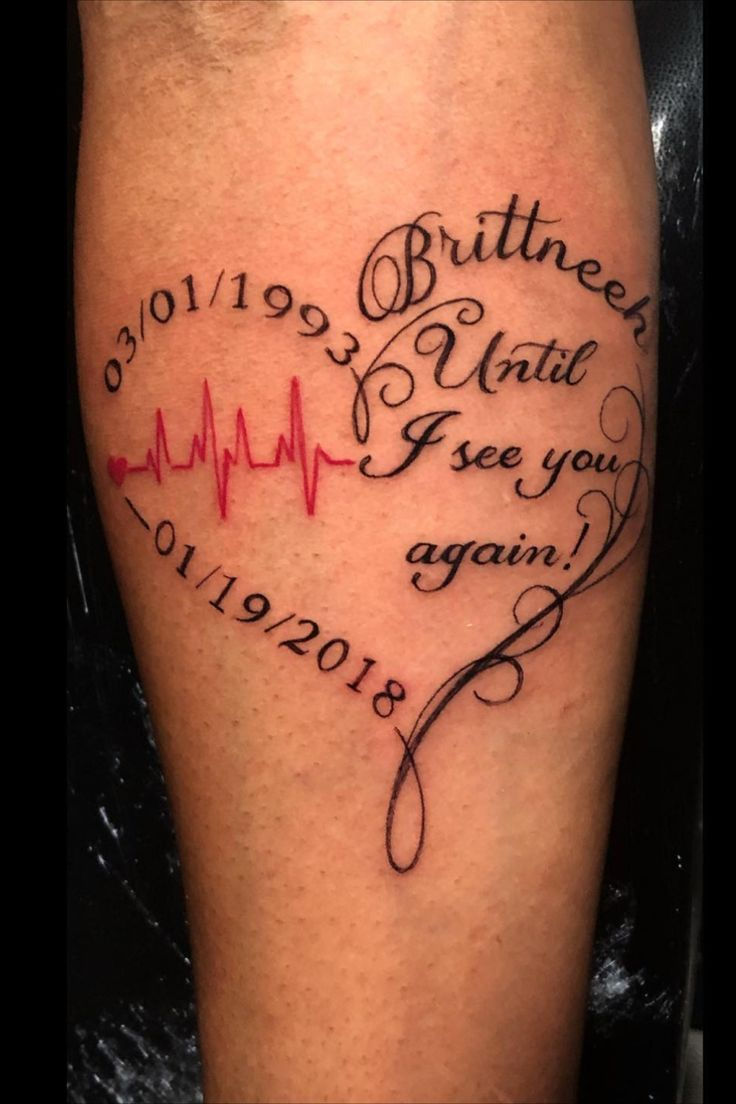
Name plus date: Simple. Clear. Timeless. Doesn't require interpretation. "John 1970-2024." People know exactly what it means. It's honest. No fancy design needed.
Their handwriting: This hits different. It's not a portrait. It's them in a different way. Their signature. A note they wrote. Words they actually wrote in their actual handwriting. There's something about seeing their handwriting on your skin that's more personal than a portrait sometimes.
Symbol: A heart if they loved hard. Angel wings if you believe in that. A bird if they were free-spirited. A cross if faith mattered. An infinity symbol if you want to say "forever." Symbols let you honor them without spelling it out.
Quote or phrase: Their favorite saying. Something they always told you. Words that capture who they were. "Live boldly." "Never stop dreaming." Whatever they lived by.
Multiple elements: Portrait plus their name plus a date plus maybe a symbol, all integrated together. This is sophisticated. Requires an artist who can make it flow. But when it works? It tells the whole story.
HEALING AND WHAT TO EXPECT

Week one: Your tattoo looks angry. Red, swollen, weeping. It's gross. That's normal. Your body's fighting back. You'll cry looking at it—and not just from emotional reasons. The physical pain is there. That's okay.
Emotionally? Looking at the tattoo might hit you hard. You might break down. You might feel guilty. You might feel relieved. Grief is weird when it's staring you in the face permanently.
Physical care: Use good ointment (Aquaphor works), gentle washing, loose clothing. Let your artist tell you specifics.
Week two: Scabbing and peeling. Intense itching. DO NOT SCRATCH. Seriously. One scratch and you've damaged the healing. One scratch and you might be looking at touch-ups.
Emotionally: The tattoo is becoming "real" now. Permanent. You're integrating this into your identity. It's settling in.
Month two: Fully healed. You can see what you actually got. This is when the grief hits sometimes in a new way—you have this permanent reminder and it's really sinking in.
IMPORTANT: THIS ISN'T THERAPY
A memorial tattoo is beautiful. It's meaningful. But it's not a substitute for actually processing grief.
If you're struggling—if the loss is destroying you—please talk to someone. A therapist. A grief counselor. A support group. A memorial tattoo is a companion to your grief journey, not the journey itself.
Grief is complicated. A tattoo is permanent. They're not the same thing.
BOTTOM LINE
You're not just getting a tattoo. You're saying: "You mattered. You still matter. I'm keeping you with me."
That's worth doing well.
Take time. Don't rush. Find an artist who gets it. Pick placement based on how you grieve, not how it looks. And know that this tattoo will probably mean more to you in ten years than it does the day you get it.
It becomes part of your story. Part of how you carry them forward.




Conclusion
Memorial tattoos are a powerful and meaningful way to honor the memory of a loved one who has passed away. They provide a tangible and permanent reminder of the love and connection shared with that person, and can serve as a source of comfort and healing in the face of grief and loss.
When considering a memorial tattoo, it's important to approach the decision with careful thought and consideration. This includes choosing a design that truly captures the essence of the person being remembered, finding a skilled and experienced tattoo artist who can bring that design to life, and being mindful of cultural and religious considerations that may impact the tattoo.
The process of getting a memorial tattoo can be emotionally challenging, as it often involves confronting the pain of loss and grief. However, it can also be a deeply therapeutic and transformative experience, providing a sense of catharsis and healing that can help individuals cope with their loss.
Once the tattoo is complete, proper aftercare is essential to ensure that it heals properly and maintains its appearance over time. This involves following a series of steps and precautions to keep the tattoo clean, moisturized, and protected from damage and fading.
Ultimately, a memorial tattoo is a deeply personal and meaningful way to keep the memory of a loved one alive and close to the heart. It is a reminder that although they may be gone, the love and connection shared will endure forever. Whether as a source of comfort, a conversation starter, or a tribute to a life well-lived, a memorial tattoo is a powerful and enduring expression of love and remembrance.
If you are considering a memorial tattoo, take the time to explore the different options available and find a design that truly speaks to you and honors the memory of your loved one. With careful planning, consideration, and aftercare, a memorial tattoo can be a beautiful and meaningful way to keep their memory alive and close to your heart for years to come.
See More: ⤵
Evil Eye Tattoo: The Mystique of the Meanings and Inspiration
The Ultimate Guide to Tattoo Designs for Men: Unleashing Your Inner Warrior
Eyebrow Tattoo: The Definitive Guide for Bold and Beautiful Brows
Forearm Tattoos: Unleashing Your Personal Style on Skin Canvas
Is an Inner Forearm Tattoo Painful? Your Complete Guide to Forearm Tattoo Pain
Butterfly Tattoos for Women in 2024: Embracing Transformation
Discover the Most Sensitive Part of the Body to Get a Tattoo
Best Friend Tattoos: Celebrating the Unbreakable Bond of Friendship
Wave Tattoo: Unleashing the Power and Beauty of the Ocean on Your Skin
Wrist Tattoos: Meaningful Designs and Ideas for Your Next Ink
Halloween Tattoos: Spooky and Creative Ideas for Ink Enthusiasts
Japanese Tattoo: Exploring the Rich History and Symbolism of Irezumi
Infinity Tattoo Ideas: Endless Inspiration for Your Next Ink
Cat Tattoos: Meanings, Designs, and Ideas for Feline-Inspired Ink
Feather Tattoo: Meanings, Designs, and Ideas for Your Next Ink
Lotus Flower Tattoo: Meanings, Designs, and Ideas for Your Next Ink
Polynesian Tattoo: Unraveling the Meanings and Traditions Behind the Ancient Art
Birth Flower Tattoos: Celebrating Your Birthday with Floral Ink
Forearm Tattoos for Women: Embracing Femininity and Self-Expression
Head Tattoos for Guys: Bold Designs and Crucial Considerations
Forearm Tattoos: Unleashing Your Personal Style on Skin Canvas
Arm Tattoos: Your Ultimate Guide to Inked Sleeves and Beyond
Phoenix Tattoo: Rising from the Ashes with Stunning Design Ideas
Heart Tattoo: Meanings, Designs, and Ideas for Your Next Ink

Comments